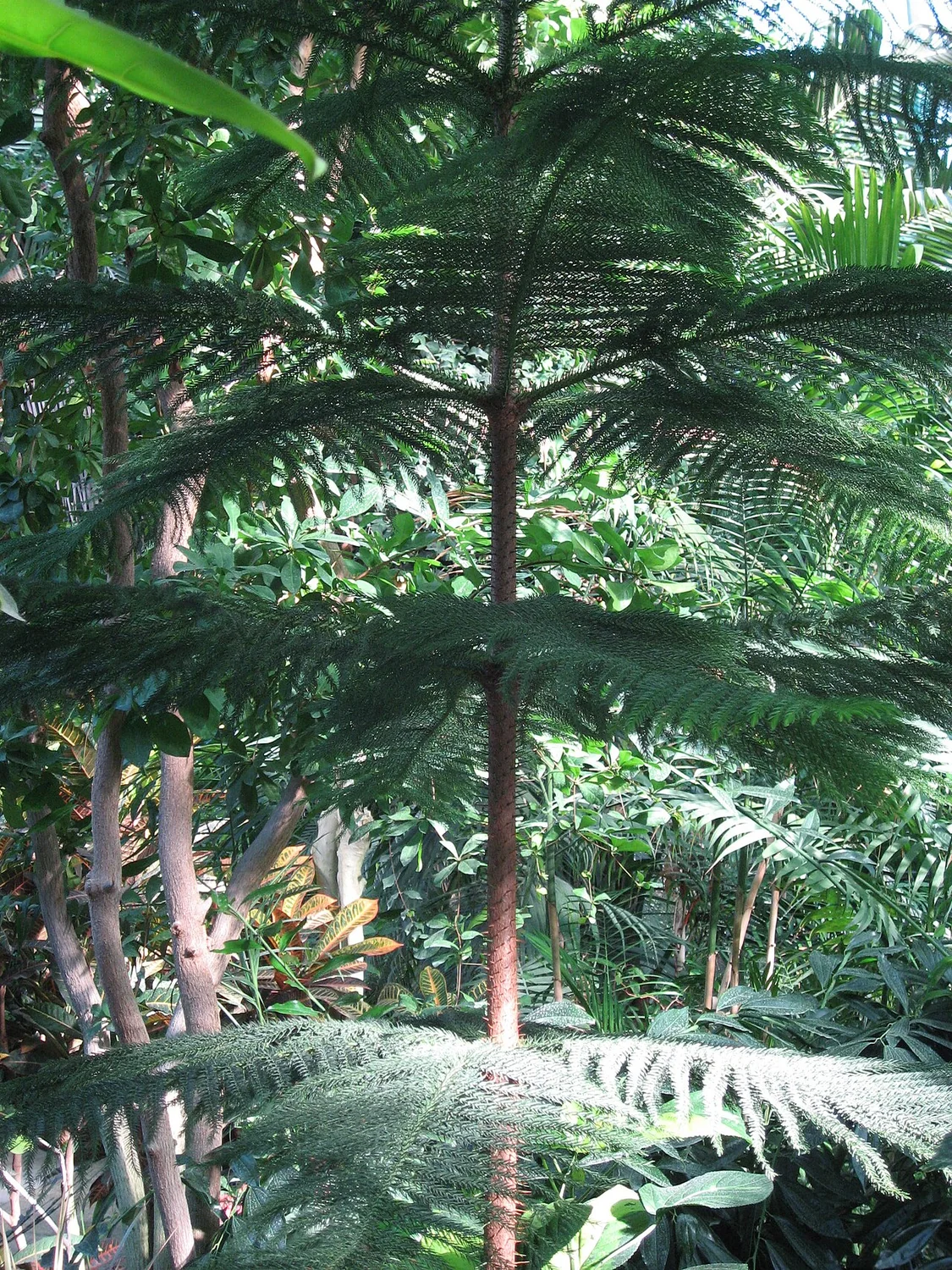
An island conifer beyond the holiday display
Norfolk Island pine is an evergreen conifer with a tropical island origin, not a small version of the cold climate pines commonly cut for Christmas. Araucaria heterophylla is native to Norfolk Island in the southwestern Pacific. Young plants have tiered branches and soft looking needlelike foliage, while mature trees in suitable outdoor climates can reach a scale far beyond an ordinary room. Its indoor value lies in the orderly framework of a juvenile tree. A specimen sold during the holiday season still has year round growing requirements, so it should not be treated as a disposable decoration that can remain in a dark warm corner indefinitely.
Identification can be complicated by the similar Cook pine, Araucaria columnaris, which also appears in the nursery trade. Retain the grower's information rather than deciding from a common seasonal label alone. Several seedlings may be planted together to create a denser miniature forest, and each stem should be checked for living tips and a sound base. The branch tiers need clearance around them because broken or badly browned lower branches are not quickly replaced. Choose a tree with a balanced outline rather than one already leaning toward a distant light source. A healthy leader at the top is particularly important to its continuing architecture.
Light and a workable indoor position
Provide very bright daylight and turn the pot in modest increments so one side does not remain permanently shaded. A suitable window or bright conservatory is more credible than a central table illuminated mainly by room lights. Introduce stronger direct sun gradually if the plant was previously under shade. Do not confuse a conifer's familiar winter appearance with tolerance of freezing conditions; this is a plant from a mild island environment. A cold draft against the foliage or root ball can cause damage. Conversely, a radiator immediately beneath the crown creates a hot dry microclimate that is unlike the even conditions the tree prefers.
Water, roots, and a draining container
Root moisture should remain reasonably consistent, with drainage after watering. Check the upper mix and the deeper ball before deciding to irrigate. Allow some surface drying, but avoid repeatedly drying the whole container hard, especially when the fine branches are actively growing. Water thoroughly enough to reach all of the roots and remove the excess from the cover or saucer. A decorated pot may conceal its drainage tray, so arrange access before seasonal ornaments are added. If the tree has been wrapped in foil, make sure the wrapping is not collecting water around the nursery container. Presentation should never turn the root environment into a reservoir.
An airy potting mix and a modestly sized container make moisture easier to control. Repot when roots have occupied the available space rather than giving a small tree an enormous tub immediately. Support the root ball carefully, retain the established level of each stem, and avoid unnecessary root stripping. A grouped planting can remain together if it is sound; dividing every seedling merely to create individual trees may cause more damage than benefit. Keep a stable base beneath the pot, since a tall narrow tree has considerable leverage if brushed by a person or an animal. The branch tiers should not be used as carrying handles.
Keeping the leader and branch tiers
Pruning is not equivalent to shaping a broadleaf shrub. The leading shoot defines the upward structure, and cutting it off to reduce height can permanently change the appearance. Do not buy a tree already near the ceiling with the assumption that it can simply be topped every year. Dead or irreversibly browned branches can be removed carefully, but repeated clipping will not produce a dense new lower skirt where old tiers have been lost. If a plant has become too large or too damaged for its place, assess another suitable growing location. The natural architecture is part of its appeal and deserves room to remain legible.
Dry indoor air and inconsistent roots can contribute to browning, but the precise pattern should be examined. Brown lower branches after a prolonged dry interval differ from general decline above wet mix. A few damaged tips do not justify saturating the pot or applying strong fertilizer. Clean dust gently, avoiding rough wiping that breaks fine branchlets. Inspect for mites, scale, or mealybugs where appropriate. Feed lightly during active growth and reduce the routine when light and extension slow. A tree kept near bright glass may continue developing differently from one in a dim heated room, so shared calendars are less useful than observations of the individual plant.
Holiday use needs a light touch. Avoid heavy ornaments, hot lamps, artificial snow coatings, or sprays that may damage living foliage. A few lightweight decorations placed without bending branch tips are more reasonable, and they should be removed when the display ends. Keep electrical accessories and loose small ornaments out of reach of children and animals. The plant itself is not an edible household tree, and chewing foliage should be prevented. A tree given in winter also needs protection during transport between a warm shop and a warm home. Even a short wait in a freezing vehicle can undermine an otherwise careful gift.
Meaning without unsupported promises
Its established modern role as a living holiday tree gives it a genuine seasonal association. A giver may extend that into a personal message about continuity after the celebration or the pleasure of caring for something beyond one event. That is different from claiming that the species has a universal sacred meaning or guarantees peace in a household. Its island origin and distinctive branch tiers can also interest someone who enjoys geography and conifers. Describe it as Norfolk Island pine while acknowledging that it is an araucaria, not a member of the true pine genus. Accurate identity makes the holiday story more engaging rather than less.
A gift matched to the recipient
Norfolk Island pine can suit a winter celebration, a housewarming, or a requested addition to a bright conservatory. Ask whether the recipient has a year round position before giving a decorated specimen. It is a poor surprise for a small dark apartment where the owner would have to cut the top immediately or keep it beside a heater. A younger healthy tree may be more manageable than a tall impressive one. Include care information that continues beyond the holiday, keep the functional pot accessible, and explain the importance of the leader and lower branch tiers. The gift succeeds through a suitable home, not through decorations alone.