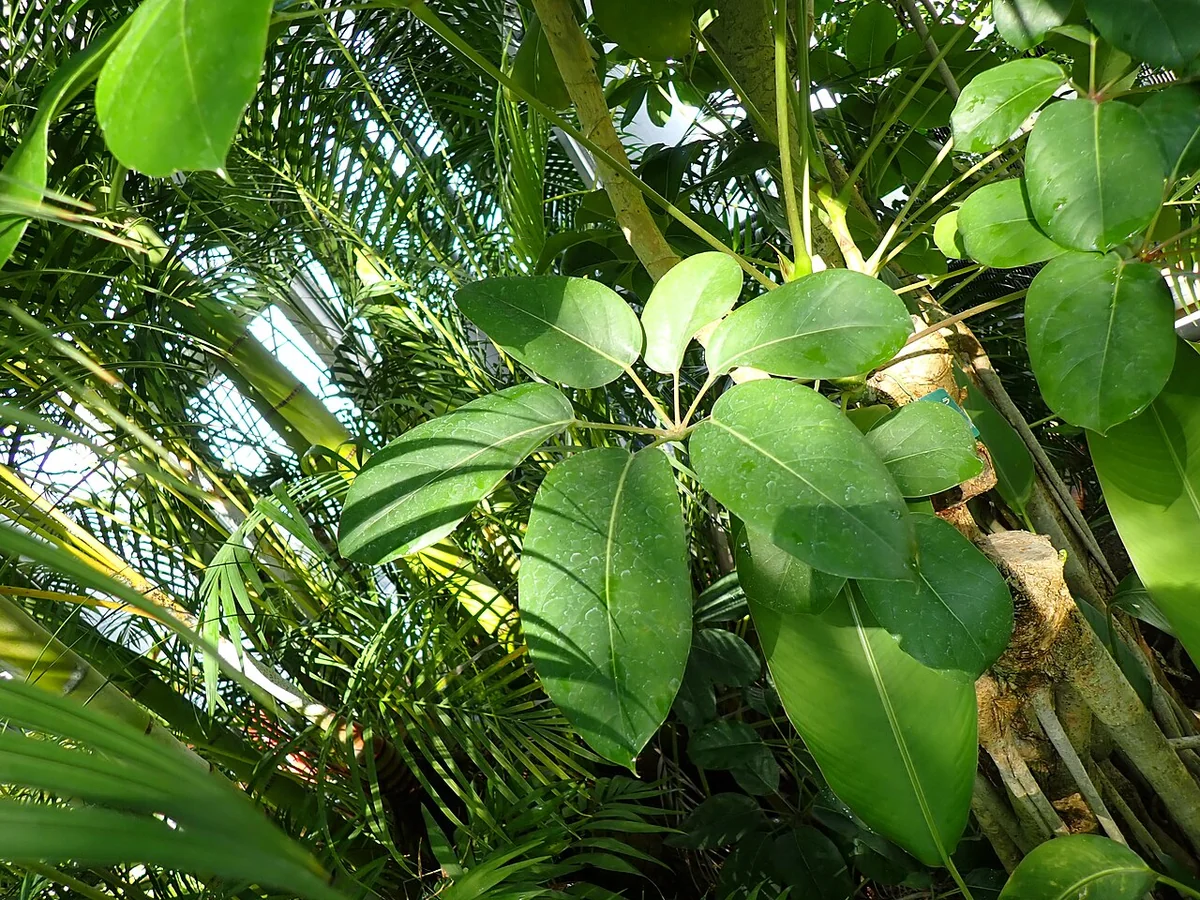
An umbrella canopy that needs space
Australian umbrella tree has a more expansive presence than the dwarf umbrella tree commonly kept on a desk. Its long stalked compound leaves carry large leaflets arranged around a central point, producing an open tropical canopy above a woody trunk. Heptapleurum actinophyllum is still widely labelled Schefflera actinophylla in horticulture. Its native range includes northeastern Australia and nearby tropical regions such as New Guinea. Mature outdoor trees can become substantial and produce conspicuous branching flower clusters. A juvenile indoor specimen is being kept at a manageable stage, and its long term requirements should be considered before the initial foliage display is purchased.
Size is the first honest distinction for a home or office. A tall stem may fit under a ceiling while the leaf clusters already extend into the room on long petioles. Give the tree enough width that doors, curtains, and passing people do not repeatedly strike the foliage. A public atrium or bright spacious room is generally a more credible setting than a narrow bedroom corner. If the owner wants a consistently small plant, the dwarf species or another compact subject may be a better match. Cutting a vigorous large species into a tiny shape forever is a continuing commitment, not a feature supplied by the nursery pot.
Light and a workable indoor position
Provide strong filtered daylight across the crown. A young tree can be gradually acclimated to some direct sun, but foliage raised in shade should not be placed immediately against intense hot glazing. The broad leaflet clusters can shade lower branches, so evaluate light from the plant's perspective rather than the brightness perceived by someone standing nearby. A long bare trunk with all new growth near a distant window suggests that the indoor arrangement may be limiting the plant. Rotate carefully if needed for balance, and use a suitable growing light where daylight cannot support the complete canopy. A dark lobby is a display location, not automatically a growing location.
Water, roots, and a draining container
Check root moisture before irrigation and let the upper layer lose some water between drinks. A large canopy can use a substantial amount in warm bright weather, yet the same pot can remain wet when indoor light is poor. Water slowly over the whole surface until excess leaves the base, then clear the drainage tray. Do not rely on a few small splashes near the trunk. Equally, avoid letting an outer planter become a reservoir that continually wets the lowest roots. After pruning, reassess the drying interval because the reduced leaf area changes water use. The size of yesterday's canopy should not dictate tomorrow's watering.
A stable container is essential for this species. Choose a base that can resist the leverage of long branches and keep the functional pot accessible for inspection. As roots fill the existing volume, move up gradually into an open mix intended for indoor containers. A very large ornamental tub of dense compost is difficult to keep evenly aerated. Keep the trunk at its original level and look for circling roots that can be eased without aggressive stripping. A wheeled support may help with maintenance of a large tree, provided it is designed for the load and cannot roll when the crown is touched.
Training and ongoing maintenance
Pruning should establish a branch framework that fits the available space. Shortening selected vigorous shoots can encourage a fuller outline, while removing poorly placed branches creates clearance. Repeatedly shearing the exterior into a tight ball can conceal a bare interior and does not remove the need for better light. Take care with sap and dispose of cut foliage where animals cannot reach it. If a tree has already become too large, assess whether a different location is more reasonable than repeated drastic reductions. A plant that needs major structural work every season may be telling the owner that its species and the room are mismatched.
Indoor maintenance includes cleaning leaflets individually, checking their central junctions, and looking closely at stem surfaces. Scale insects and mealybugs can hide among the many protected points in the canopy. Mites may become apparent in dry conditions through pale stippling and fine webbing. Check a new tree before placing it beside an established collection. Feed only in proportion to active growth under adequate light, and follow the instructions for the actual fertilizer. Leaf loss after cold air exposure or root saturation should not be treated automatically as nutrient deficiency. Record major moves and pruning so later changes have a practical history to compare.
Outside its native region this tree can be invasive where climate and pollination allow it to reproduce. That matters when an indoor specimen eventually becomes inconvenient: releasing it into a warm landscape or natural area is not a responsible disposal plan. Check local horticultural guidance before any outdoor planting. Indoors, its foliage also contains irritating calcium oxalate compounds, making access by pets and children relevant. A large plant does not become safe merely because its mature leaves are elevated; fallen leaflets remain within reach. Discuss those constraints before selecting it for a family or shared workplace rather than after a recipient has accepted a difficult tree.
Meaning without unsupported promises
The radiating leaf clusters can be interpreted personally as an image of connection or many parts forming a whole, which may suit a collaborative workplace. That is an optional visual reading rather than an established promise associated with the species. Its genuine story lies in Australian and neighbouring tropical forests, its imposing mature architecture, and its adoption into warm landscape and interior horticulture. A gift connected with Australia should distinguish this origin from the recipient's cultural identity and preferences. Avoid assigning sacred meanings, wealth claims, or universal protective powers simply because a decorative name contains the word umbrella.
A gift matched to the recipient
Australian umbrella tree is most suitable for an experienced owner with a bright large room, an atrium, or a protected tropical collection. It may mark a studio expansion, a substantial new office, or a requested addition to a conservatory. It is not a considerate unannounced gift for a small apartment or someone who wants a permanently compact plant. Confirm how the pot will be lifted, drained, and eventually repotted, and choose a size that the recipient can manage now. A botanical label using both names and realistic information about future width are part of the gift. Its impressive appearance should arrive with equally clear expectations.