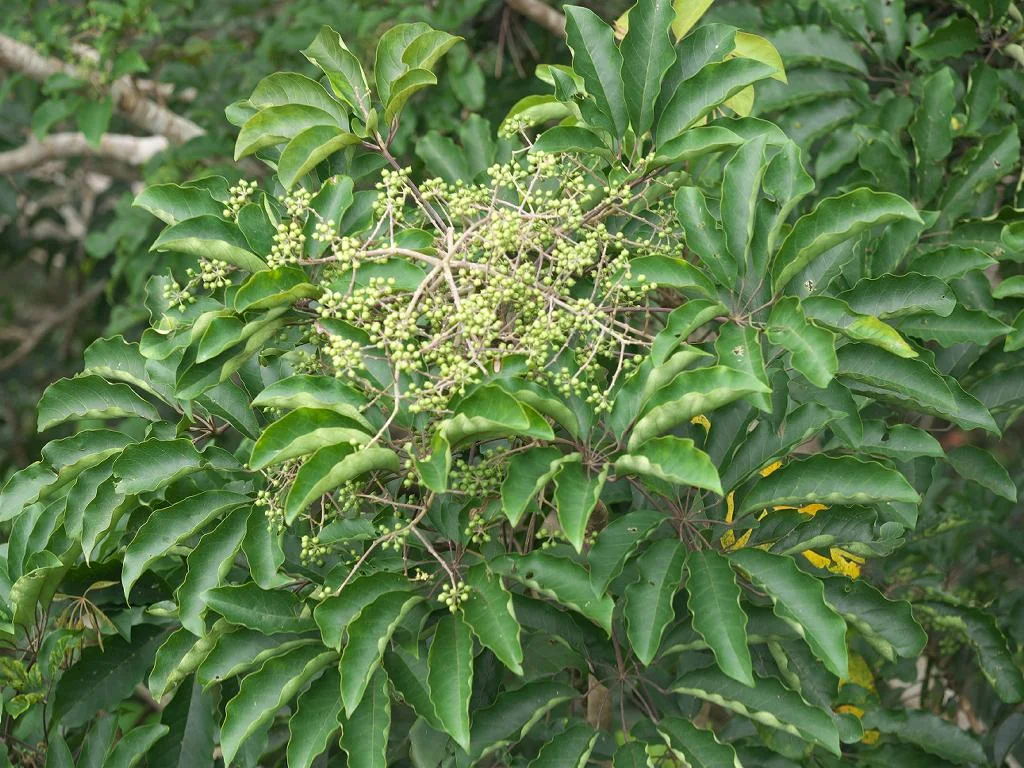
An Asian tree with several botanical names
Seven leaflet umbrella tree is a less familiar member of the aralia family whose naming history is important to an accurate purchase. Current botanical references use Heptapleurum heptaphyllum, while Schefflera heptaphylla and Schefflera octophylla occur in older literature and collections. Kew records a native range from Assam across parts of southern and eastern Asia to Japan and the Philippines. It is a shrub or tree primarily associated with subtropical conditions. Those facts distinguish it from a generic retail umbrella plant. A labelled juvenile can be interesting in a bright protected collection, but ordinary low light office performance should not be assumed merely from its family resemblance.
The compound leaf is the main decorative feature. Several leaflets spread around a point at the end of a stalk, giving the foliage depth as different clusters overlap. The common English description is useful but should not be used as a strict counting test for every leaf. Leaflet number and appearance can vary with growth. Buy from a source able to identify the plant, especially when its care is being compared with the more commonly sold dwarf umbrella tree. Keep the original label and record any older name supplied with it. That simple practice prevents a later photograph search from substituting another species with a similar silhouette.
Light and a workable indoor position
A bright conservatory or spacious well lit room is a more plausible indoor setting than a desk far from a window. Provide filtered daylight initially and increase direct exposure gradually when the nursery conditions are unknown. Observe whether new growth remains compact and whether the lower canopy retains leaves. If the plant is stretching and losing interior foliage, an attractive pot will not compensate for the missing illumination. Consider the seasonal temperature of the entire growing area, including nights when heating is reduced. A plant protected during summer may face very different conditions beside winter glass, so a long term site needs more thought than a temporary decorative placement.
Water, roots, and a draining container
Treat watering as a response to the root environment rather than as a borrowed schedule from another umbrella tree. Check the upper mix, the deeper ball, and the weight of the container. When it needs irrigation, distribute water through the full root area and allow the surplus to drain. Do not leave a concealed pool beneath the inner pot. A young plant in a small nursery container may dry quickly during extension, while a newly repotted tree can remain wet outside the old root ball. Monitoring those differences is especially useful with an uncommon plant for which the owner has limited experience in the specific room.
An open container medium gives the roots a better balance of moisture and air than compacted garden soil. Keep the original planting depth and increase pot size conservatively as roots occupy the available space. Avoid moving a small plant directly into an oversized floor tub simply to make it look like a finished tree. If a larger cover is desired, support the functional inner pot securely and preserve access to drainage. Inspect the base for ties, accumulated decorative material, or damaged tissue. The tree's future width and the route through doorways also belong in container planning, because maintenance becomes difficult once the plant can no longer be moved comfortably.
Training and ongoing maintenance
Build an appropriate framework while the plant is manageable. Prune an unsuitable extension above living growth rather than repeatedly shearing all the leaf clusters at the same height. A gradual approach preserves enough foliage to support recovery and allows the response of this particular specimen to be learned. If propagation is attempted, consult a species appropriate reference instead of assuming any detached leaflet can become a tree. A cutting needs suitable stem tissue and conditions. Keep propagation material clearly labelled, especially in a collection containing several umbrella species. The aim is to preserve identity as well as produce new growth.
Leaf maintenance is an opportunity to inspect the complex junctions where pests can be overlooked. Wipe individual leaflets when dusty and look for scale, mealybugs, or mite damage on both surfaces. A pale pattern should be compared with the natural leaf colour and any recent exposure change before treatment. Keep the crown clear of a direct heater or air conditioning stream. Feed in modest amounts only while extension and the available light support it. The requirements of a vigorously growing outdoor subtropical tree cannot be transferred unchanged to a juvenile indoors. If growth slows seasonally, investigate the environment before increasing the dose.
Because this is an uncommon interior subject, uncertainty should be stated honestly. Native distribution and a plant's presence in botanical collections provide useful context, but they do not prove that every household setting will suit it. Keep a simple record of watering intervals, new leaves, and temperature changes while the plant settles. If continuing decline occurs, a better protected growing area may be more appropriate than repeated chemical or nutritional intervention. Handle pruning material cautiously and prevent children or pets from chewing foliage, as the plant belongs to a group commonly associated with irritating compounds. Seek specific identification rather than treating an unknown aralia as an edible plant.
Meaning without unsupported promises
No universal gifting tradition needs to be attached to the seven leaflet name. A giver may personally connect its radiating leaves with learning, cooperation, or curiosity about Asian botany, provided that interpretation is not presented as an ancient guarantee. Its documented naming changes also make it a useful gift for someone interested in taxonomy: one living plant can demonstrate why retail names and modern botanical names sometimes diverge. Avoid inferring sacred or medicinal significance from the origin alone. A thoughtful message can explain the recipient's particular interest and the reason this less common species was chosen, without borrowing the cultural history of an unrelated tree.
A gift matched to the recipient
Offer it for a collection milestone, a conservatory addition, or a requested botanical gift rather than as a supposedly effortless office accessory. The recipient should have appropriate light, stable temperatures, and the willingness to observe an unfamiliar plant. Discuss the eventual canopy and the practicalities of moving its container. A correctly identified small specimen may be more valuable than a large plant of uncertain identity. Include the botanical synonyms, the provenance supplied by the grower, and a realistic account of the current care. That information makes the gift an informed collaboration with the owner rather than a decorative obligation they did not choose.