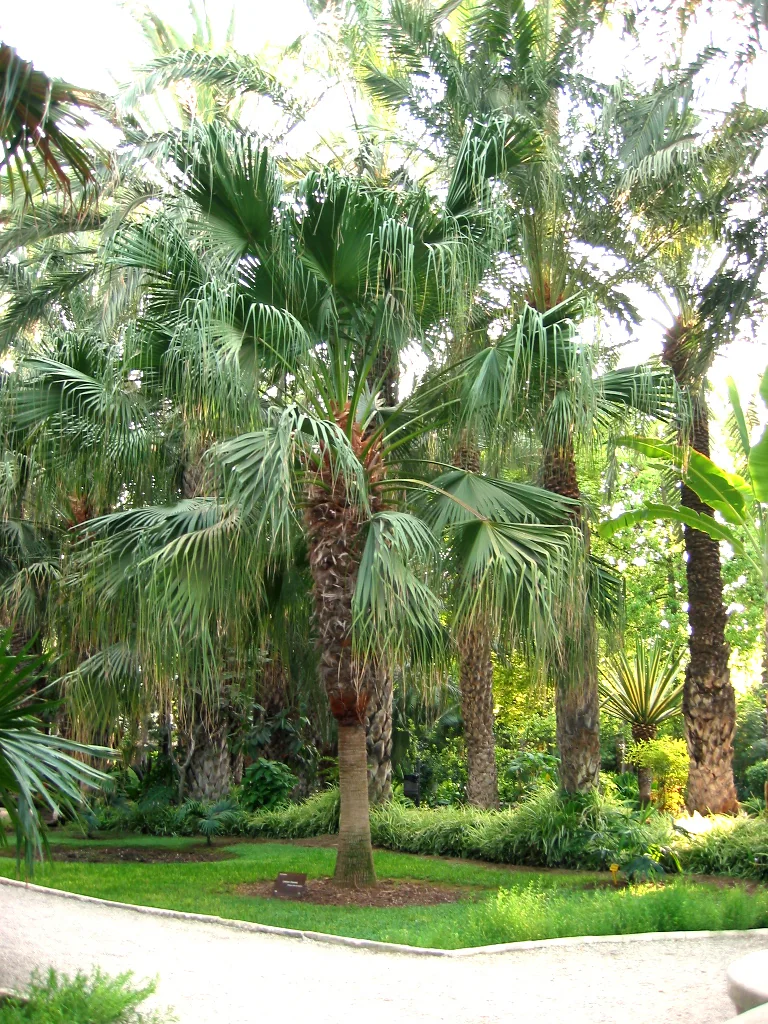
The Developing Fountain-Shaped Fan
The Chinese fan palm becomes distinctive when its long leaf segments begin to droop. Livistona chinensis develops broad fans whose ends hang downward, creating the fountainlike canopy behind another of its common names. Young nursery plants may carry relatively simple leaves before that mature shape becomes clear. It is therefore worth comparing more than one stage when deciding whether a small pot will suit a room. A fan that looks modest when folded for transport can occupy a wide circle after opening. This is a palm for a bright, roomy position, not a narrow slot that can be maintained by clipping its edges.
Its native range lies in eastern Asia, including parts of southern China and Japan and neighboring islands. The genus name honors Patrick Murray of Livingston, linking the palm with a history of botanical collecting rather than defining where it should grow indoors. It is widely cultivated beyond its natural range and can escape in some warm regions, so outdoor planting or disposal should take local guidance into account. In an indoor article, that context is a reminder to treat the palm as a named species with a geographic history, rather than as an anonymous tropical decoration whose future can be ignored.
A Bright Space with Canopy Clearance
Bright conditions are important for a convincing long-term container display. A glazed entrance hall protected from cold drafts, a conservatory, or a sunroom generally offers a better prospect than a dim conventional office. Introduce direct sun gradually if the palm was produced under shade. The pot and roots should be protected from excessive heat even when the foliage receives useful light. Check how a new fan will open near curtains, overhead lights, or neighboring plants. Once an expanding leaf has been damaged against a hard surface, moving the pot afterward cannot restore its original outline.
Water when the upper medium has dried somewhat, then wet the occupied root ball thoroughly. An actively growing fan palm in a bright warm setting may use moisture quickly, while a cool resting container can remain damp for much longer. Feel or probe the mix carefully and compare the pot's weight when practical. Drainage should be visible and reliable. A large decorative vessel that traps water below a hidden inner pot creates uncertainty at precisely the point where it matters most. Avoid using a dry-looking top dressing as the sole cue, since gravel can conceal a saturated layer underneath.
Deep Roots and Carefully Handled Petioles
Select a sturdy, draining pot with room for downward root development. A suitable open container compost is preferable to heavy soil scooped from the garden. Repot before a badly congested root system makes watering unmanageable, but do not disturb the palm repeatedly in pursuit of rapid size. Keep the trunk base at its previous level and protect the central growing spear during handling. If a nursery has planted several seedlings together, remember that each can eventually require considerable canopy space. A multi-plant arrangement may outgrow a room sooner than a single palm with the same initial height.
Leaf maintenance has some practical hazards. Petioles can bear sharp teeth, especially on larger plants, so wear appropriate protection and handle them with awareness of nearby people. The drooping segment tips should not hang into a busy walkway or over an area used by small children. Remove fully dead fronds with a careful cut clear of living trunk tissue. Never cut into the crown to limit height. Trimming a fan into a compact rounded shape leaves many cut edges and weakens the natural effect. If space becomes insufficient, relocation is a more realistic solution than repeatedly altering every leaf.
Nutrition and Inspection within the Fan Folds
Feed moderately while the palm is producing new growth, using an appropriate labelled product. More fertilizer does not compensate for an inadequate window. Browning at the fan tips can reflect several causes, including irregular moisture, salts, root problems, and physical wear. Inspect the newest leaf and consider its growing conditions before identifying a deficiency from one older frond. Keep the drainage path functioning as roots expand. In large containers that are difficult to move, plan a safe way to collect and remove surplus water rather than gradually reducing each watering to a token amount that never reaches the lower root ball.
Check the deep folds and lower surfaces for scale and mites. A broad fan can conceal pests near its petiole even when the outer tips look acceptable. Dust can be removed with gentle support and a damp cloth, but pulling hard across multiple narrow segments risks tearing them. Seasonal changes in a sunroom also need attention: glass can produce heat during a bright day and a sharp temperature drop after dark. A plant tolerating some outdoor chill when established should not be assumed to tolerate a cold, saturated root ball in a small indoor container beside an opening door.
A Conservatory Gift with a Future Footprint
Chinese fan palm can be an impressive agreed gift for someone establishing a conservatory or a spacious collection. The spreading fan can personally suggest openness or a broad welcome, but that association should be stated as a chosen message rather than a universal cultural meaning. Its origin does not justify assigning an invented symbolic role to every Chinese household. Give the botanical name and a realistic description of the mature leaf spread. Confirm that the recipient wants a palm with toothed petioles and has a safe location. An unexpected large specimen is difficult to accommodate politely when the home has no suitable bright floor space.
The most satisfying display allows the palm to reveal its developing fountain shape over time. Keep an unobstructed perimeter around the crown, learn how the deep root ball dries, and make seasonal adjustments without repeatedly moving it between extremes. Record the condition of new fans rather than demanding that every oldest leaf remain pristine. Store gloves beside the watering equipment so handling protection remains readily available. If indoor light proves inadequate, acknowledge the limit and choose a more appropriate setting. Livistona chinensis rewards a space that respects its architecture: a broad fan palm whose graceful tips are best preserved by generous light, room to open, and careful handling at the petioles.