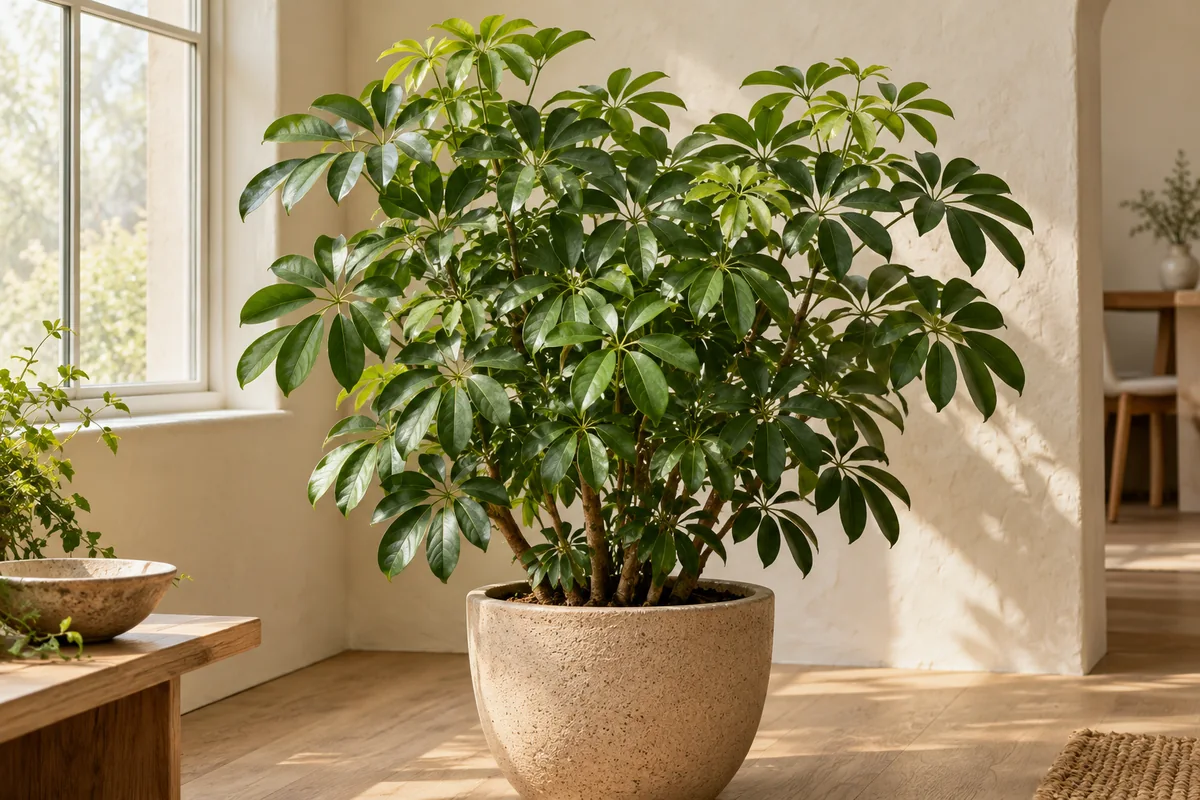
Umbrella plant can shift from a rounded bush to a tall open stem before the change seems obvious. Its clusters of leaflets keep the plant looking green even as the gaps between branches lengthen. Light and selective pruning both influence the eventual outline. A bright position encourages useful growth, while a planned cut can keep the branches within the room's scale. The dwarf umbrella plant, Heptapleurum arboricola, is also familiar under its older Schefflera name. Whatever name appears on the label, begin with the actual plant in front of you: inspect its stems, root moisture, and available daylight before deciding how much intervention it needs.
Bright indirect light suits an indoor umbrella plant, and some gentle sun can work after gradual acclimation. Variegated forms generally benefit from a bright position that protects their pale areas from sudden intense exposure. A dim corner may lead to long weak stretches and a canopy that leans toward the nearest window. Move closer in stages if needed and look at the next growth rather than expecting old stems to shorten. Keep the pot away from cold glass and hot airflow. Turn it occasionally when one side receives much more light, checking that branch tips have room to spread without pressing into furniture or curtains.
Let the upper mix dry before watering, confirming the deeper condition with a finger or wooden probe. When the root ball is ready, wet it evenly and let excess leave the drainage holes. Empty the saucer or outer container afterward. A tall leafy specimen may use more water during bright active growth than it does during a dim winter period. Fixed weekly quantities are therefore less useful than a direct moisture check. Drooping or falling leaves need an inspection of the pot first. Both prolonged dryness and damaged wet roots can affect foliage, so adding water automatically can extend the wrong problem.
Use an open houseplant mix and a container sized to the roots. Repot when roots have filled the space or the old mix no longer handles moisture predictably, increasing the diameter modestly. Keep the original planting depth and avoid burying the lower trunk to stabilize it. A suitable stake with loose soft ties can support a young stem while it develops. A heavier outer planter may improve balance, provided its base does not become a hidden reservoir. Remove the inner pot for watering when possible. Fresh mix should settle around the root ball without being pressed into a dense mass that remains wet for too long.
Prune during active growth with the future shape in mind. A cut just above a suitable leaf joint can encourage branching from nearby points, though the exact response depends on the stem and conditions. Remove a little at a time so the plant retains enough useful foliage. Several branches cut to slightly different heights often create a more natural outline than a rigid level trim. Use a clean sharp tool and protect the work surface from cut material. If the plant is very stretched, improve the light before making repeated severe cuts. New growth needs an appropriate setting to remain compact after pruning.
Leaf clusters gather dust where the stalks meet, making routine cleaning useful. Support each cluster and wipe individual leaflets gently with a soft damp cloth. Avoid pulling on the whole stalk or bending young branch tips sharply. Inspect the undersides and joints while they are accessible. Remove fallen leaves from the mix surface and check the base of the trunk occasionally. A single older leaf may finish naturally. Several clusters dropping in a short period deserves a review of watering, drainage, temperature changes, and recent moves. Keep those observations together instead of treating every fallen leaflet as evidence of a separate problem.
Feed modestly while the plant is making new stems and leaves, following the product instructions and considering nutrients already supplied by fresh mix. Stronger fertilizer cannot replace daylight and may add salts when roots are using water slowly. A pale crust around the rim or on the mix suggests a need to review the water supply and feeding rate. Flush a freely draining container when appropriate, allowing excess water to leave completely. New leaflets may be lighter at first and darken as they mature. Judge their final color after they have opened and firmed rather than reacting to the first tender stage.
An occasional photograph from the front and side makes gradual changes in branch spacing easier to see. Watch whether new stems remain compact and whether the whole canopy leans strongly toward the window. Adjust the position gradually, then use pruning to refine a shape already supported by useful light. Keep the pot accessible as the branches expand, since hidden saucers and awkward watering positions create avoidable problems. Umbrella plant is well suited to a simple indoor display when its scale is considered early. A bright stable setting, a measured drying interval, and deliberate light pruning allow the rounded leaflet clusters to remain the main feature.