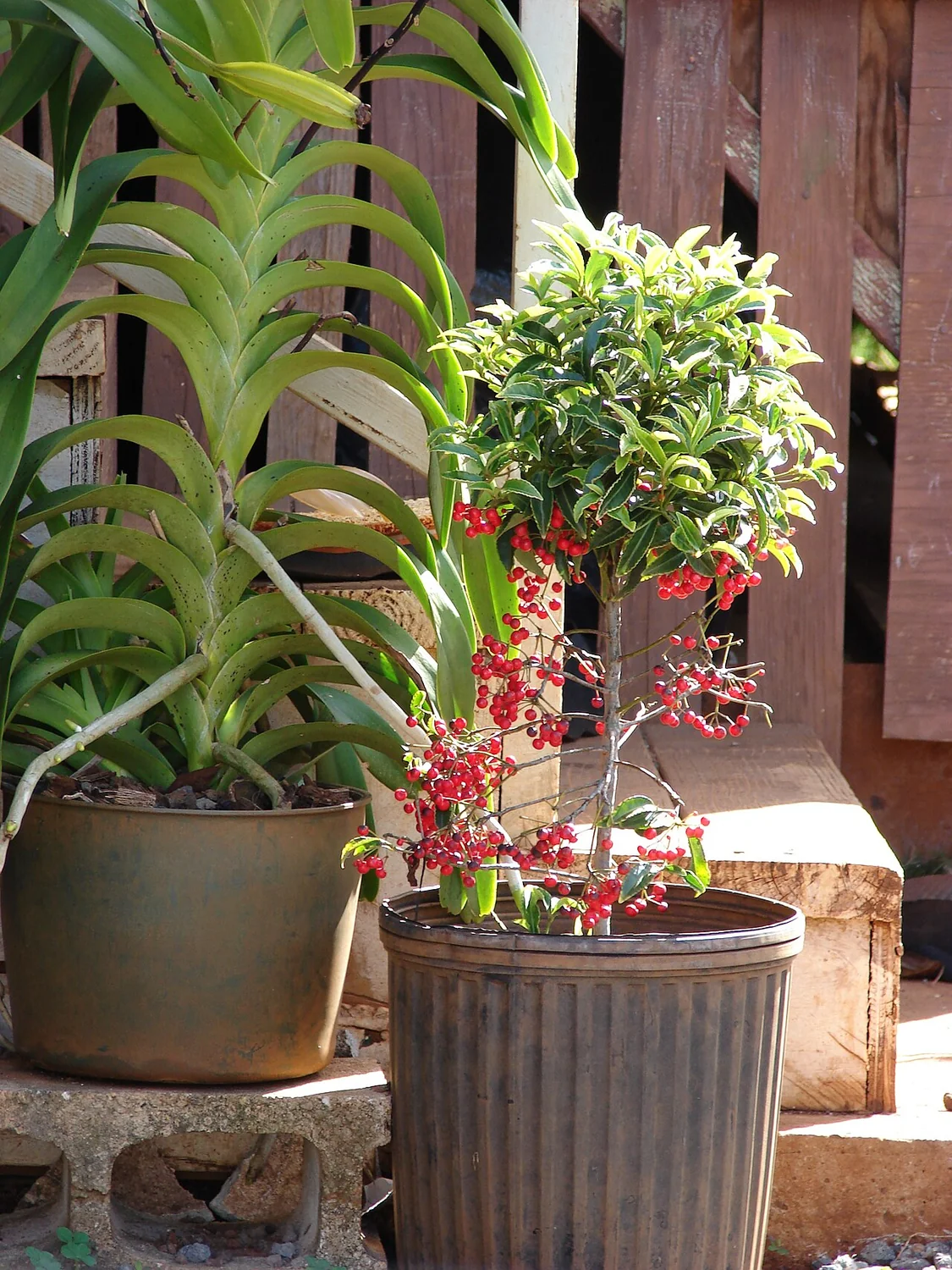
An Asian treelet with persistent fruit
Coralberry tree is a small evergreen shrub or treelet whose glossy leaves can be accompanied by persistent clusters of bright fruit. Ardisia crenata is native to parts of Asia, with a range extending from the Indian region toward Japan and the Philippines. Its leaf margins have the rounded teeth reflected in the botanical epithet, and suitable plants produce small pale flowers before the fruit develops. It belongs to the primrose family rather than to the group containing familiar food berries. In a protected container it can provide an ornamental seasonal display, but its regional suitability and potential to escape cultivation need to be considered before it is bought or given.
Identification matters because coralberry is applied to several unrelated plants. Retain Ardisia crenata on the label rather than relying on the colour of red fruit. Typical plants carry glossy red berries, while selected forms may differ in fruit colour. A plant chosen only for a heavy current display may not be the healthiest or easiest to establish. Examine the lower stem, new leaves, and root moisture beneath any decorative wrapping. Fruit persistence also should not be mistaken for proof that the plant needs no further care. The display can outlast the growing conditions that originally produced it, especially after a move into a different room.
Light and a workable indoor position
Provide bright filtered light and protection from severe direct sun. Its association with forest understories does not mean that a dim interior will maintain a compact plant or support future flowering. A bright window without harsh afternoon exposure is a more useful starting point. Very hot conditions can interfere with fruiting and damage foliage, so assess temperature as well as brightness. A cooler protected room may suit a seasonal display better than a hot position above a radiator. Keep the pot outside cold drafts and away from glass that chills the leaves at night. The whole seasonal environment matters, not simply where the berries look most decorative.
Water, roots, and a draining container
Maintain moderate moisture in an aerated root ball. Check beneath the surface before watering, then moisten the full ball and allow surplus to leave the base. The species does not benefit from remaining flooded in a wrapped holiday container. A small fruiting plant may use water rapidly in warm bright conditions, whereas a shaded cooler pot can stay damp. Use that observed pattern rather than a fixed calendar. If water runs around a dried nursery ball, rehydrate slowly and check that the centre has actually absorbed it. Repeated severe drying followed by saturation can damage roots and interrupt the foliage and fruit display.
An appropriate container mix should drain well while retaining enough moisture, with an acidic tendency suited to the plant rather than heavy alkaline garden soil packed into a pot. Repot when the roots and watering behaviour warrant it, increasing the volume modestly and retaining the stem depth. Keep decorative stones and wrapping from hiding the base or the drainage tray. A broad cover can provide stability without forcing the roots into a large wet tub. When replacing surface mix, avoid damaging shallow roots simply to obtain a perfectly smooth appearance. The functional root arrangement should remain easy to inspect after the seasonal decorations have been removed.
Training and ongoing maintenance
Flowering and fruiting are linked stages, so pruning should account for the current display and future growth. Repeatedly cutting every outer tip can remove potential flowering material, while allowing a crowded interior to persist can reduce light and make pests harder to find. Remove damaged or unsuitable shoots selectively and keep enough healthy foliage to support the plant. Feed according to active growth and an appropriate labelled container rate, accounting for nutrients already in fresh mix. A lack of fruit after purchase does not automatically call for stronger bloom fertilizer. Maturity, temperature, illumination, pruning, and pollination conditions can all influence the outcome.
Inspect leaves and branch joints for scale, mealybugs, mites, or other pests before introducing a new plant into an established collection. Clean dust gently so the glossy surface remains observable. A naturally firm leaf and persistent fruit do not rule out root trouble beneath wet compost. If yellowing or shedding begins, compare deeper moisture, recent temperature events, and the quality of new growth. Do not assume that a damaged berry and a damaged leaf have the same cause. Keep fallen material off the mix and floor. The fruits are part of an ornamental display and should not be offered for casual tasting by children, guests, or pets.
Regional ecology before a seasonal display
Regional ecology is a decisive part of responsible care. Ardisia crenata has escaped cultivation and become invasive in parts of the southeastern United States and other suitable climates. Check current local guidance and any restrictions before acquiring it, gifting it, propagating it, or planting it outside. A container does not make every route of escape impossible, particularly when fruit can be removed by animals or discarded with garden material. Keep unwanted seed and plant debris out of natural areas. If the species is unsuitable locally, choose another gift rather than assuming a decorative seasonal intention outweighs the practical consequences of introducing a persistent fruiting shrub.
Meaning without unsupported promises
This plant does have documented festive associations. Japan's forestry research garden notes the auspicious connotations of its Japanese name and its use in New Year decoration, while Singapore's NParks records its cultivation as an auspicious potted plant for Lunar New Year sale. Those are cultural associations, not evidence that the fruit produces wealth or guarantees good fortune. Describe the relevant tradition respectfully and allow the recipient to decide whether it fits their celebration. The attractive combination of green leaves and bright berries can also support a personal message of continuity or good wishes, without turning symbolism into a factual prediction.
A gift matched to the recipient
Coralberry can be a considered New Year or seasonal gift only where it is locally appropriate and the recipient wants a fruiting ornamental. Confirm suitable light, a moderate protected environment, and a plan to keep berries away from small children and animals. It is a poor surprise for a household unable to manage fallen fruit or for a region where the species is restricted or ecologically unsuitable. Select a healthy manageable plant rather than the heaviest fruit display alone, and include the scientific name and regional care information. Good wishes should accompany a responsible choice, with an alternative selected whenever the plant's practical constraints outweigh its decorative or cultural appeal.