A Broad Leaf with a Forest History
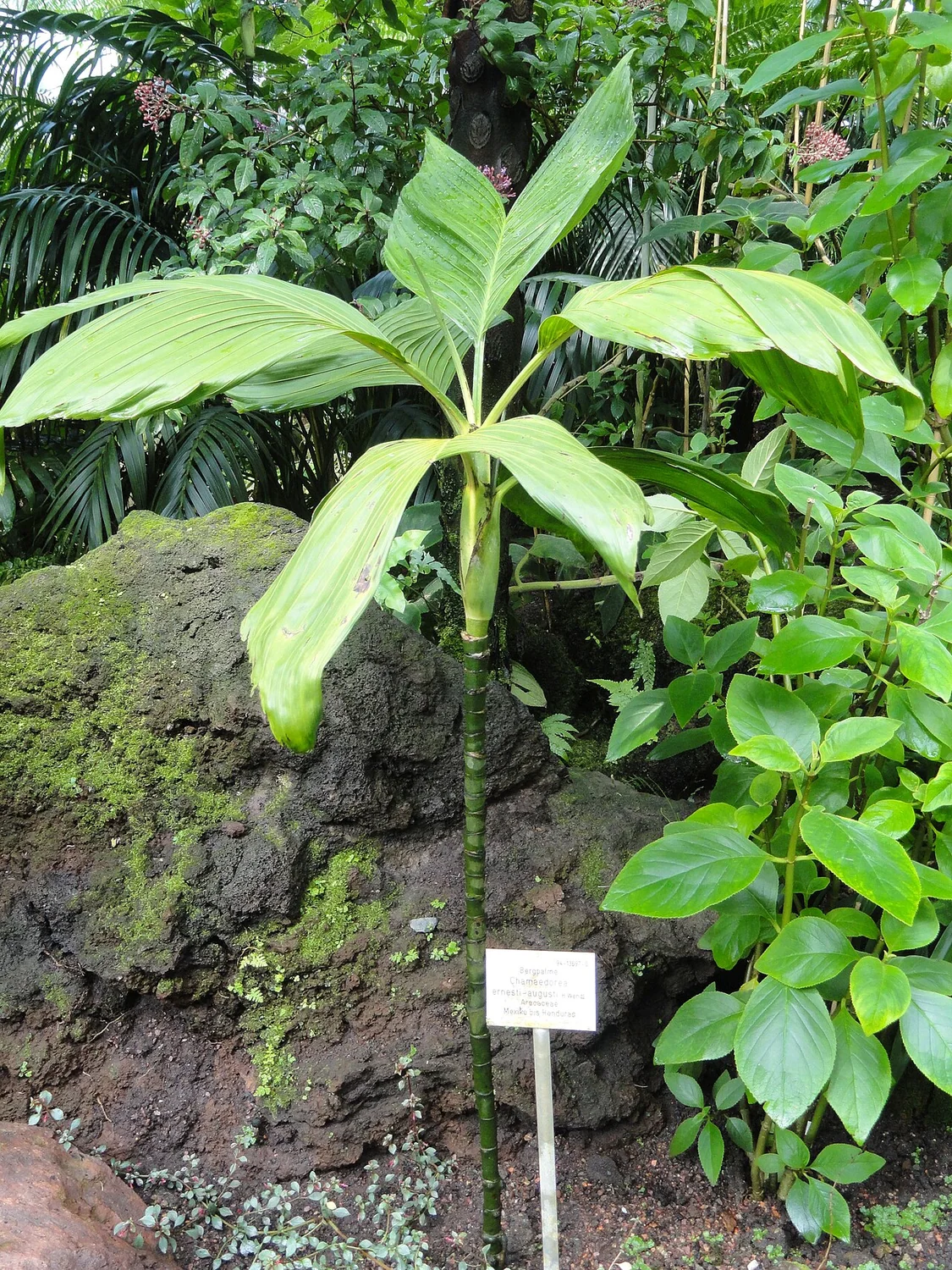
Ernest August palm is an unusual choice for an indoor collection because its leaf looks almost too broad to belong to the familiar palm family. Chamaedorea ernesti-augusti carries substantial, usually undivided blades with a distinct split at the end. They are held on a slender stem that can give a small plant the poise of a much larger specimen. Unlike a branching indoor shrub, each individual has a limited crown and a single main growing point. The relatively few leaves deserve room to develop, making a carefully placed specimen more convincing than a crowded pot selected solely for immediate fullness.
The species belongs to the forests of Mexico and neighboring Central America, including the range toward Honduras. Botanical field work also records the use of its leaves in the cut-foliage trade. That history adds context to their broad, durable form, but it is not a suggestion to harvest a small indoor plant repeatedly. An indoor specimen has far fewer leaves and less energy than an established forest population. Obtain nursery-propagated stock with a reliable identity rather than material of uncertain wild origin. The long scientific name is worth preserving, especially when broad-leaved Chamaedorea species are offered together without detailed labels.
Sheltered Daylight and Moderate Moisture
Think of a bright forest-understory display rather than a sunny tropical beachfront. Filtered daylight near a window is appropriate; abrupt strong midday sun can mark the broad leaf surface. A small office with a protected, well-lit corner may work, while a windowless meeting booth does not become suitable simply because the palm is shade tolerant. Observe how much of the canopy sees the light. If all the blades lean across a desk toward one window, reposition the container thoughtfully. A stable position is preferable to frequent rotations made only to present the most attractive leaf to visitors.
Water to maintain a moderately moist, aerated root ball. The upper layer can begin drying, but repeated complete desiccation is unhelpful for this forest palm. Pour gently enough that water does not blast medium away from the slender stem. Let surplus escape before returning the inner pot to a cover. A broad leaf may droop for more than one reason, so checking roots and moisture is more useful than responding automatically with another drink. In cooler weather or lower light, the plant can use water slowly. The correct interval must come from the pot rather than a daily office routine.
Protecting a Small Solitary Crown
The container should support the roots without overwhelming them. An open houseplant mix with useful organic moisture retention is a sensible starting point. When the pot becomes genuinely crowded or its medium deteriorates, move the root ball with minimal disruption into a modestly larger draining vessel. Do not bury the stem to hide its lower leaf scars. Those scars are part of palm development and are not a defect that needs to be covered in damp compost. A stable heavy outer planter can improve presentation without forcing an oversized volume of new growing medium around a small root system.
Since each leaf is a significant part of the canopy, maintenance should conserve good tissue. Remove loose dust with a supported damp cloth and avoid leaf-shine preparations. A blade that is scratched during moving cannot be polished back into its original condition. Keep the pot away from printer drawers, blinds, and cabinet doors whose paths cross the foliage. If an old lower leaf yellows, assess whether the rest of the crown remains sound before removing it. Do not cut a green stem back for height control. A solitary palm's growing point is not comparable to the tip of a shrub that can resprout freely.
Modest Nutrition and Protected Leaf Bases
Small flower stalks may develop on a mature plant, but the broad leaves remain the main indoor attraction. Male and female plants are separate, so flowers do not guarantee fruit. Feeding for foliage growth should be modest, applied when the plant is actively growing and in accordance with the product label. Extra feed will not immediately supply a new crown after accidental leaf loss. An owner who enjoys slow observation will find changes in spear development and leaf size informative. A plant maintained as a disposable decorative object may be replaced before its characteristic mature form has had time to emerge.
Pest checks should include the underside of each broad blade and the sheltered area where the petiole joins the stem. Scale can resemble a small stationary blemish until its pattern is examined closely. Mites may leave stippling that becomes more apparent when the leaf is held against the light. Isolate an affected plant while identifying the pest and selecting an appropriate treatment. Also consider non-pest damage from cold window glass or a sudden exposure change. The broad leaf surface records such incidents clearly, and old scars will remain even when the condition has been corrected for future growth.
Giving an Unusual Palm Thoughtfully
As a gift, Ernest August palm suits someone who values botanical distinctions and wants a restrained specimen rather than a fast-growing screen. The nearly whole leaf can personally suggest simplicity or focused attention. That interpretation should be offered as the giver's message, not as an established cultural code. Its connection with forest foliage is a better conversation starter than a fabricated legend. Confirm the recipient has a sheltered bright location and is comfortable with slow visible change. A clear label and a short explanation that the crown must remain intact are more useful additions than a large ornate cover pot that prevents drainage checks.
Let the plant mature at a scale appropriate to its roots and available light. Keep photographs of new leaves as they unfold, and compare their size with earlier blades rather than expecting continual outward expansion. If the canopy becomes awkward for the original shelf, move it to an appropriate stand before repeated collisions damage the leaves. The appeal of this palm is specific: a slender forest plant carrying remarkably broad blades. Preserving that relationship between stem, leaf, and open space is a more satisfying goal than trying to force it into the conventional outline of a many-leafleted houseplant palm.