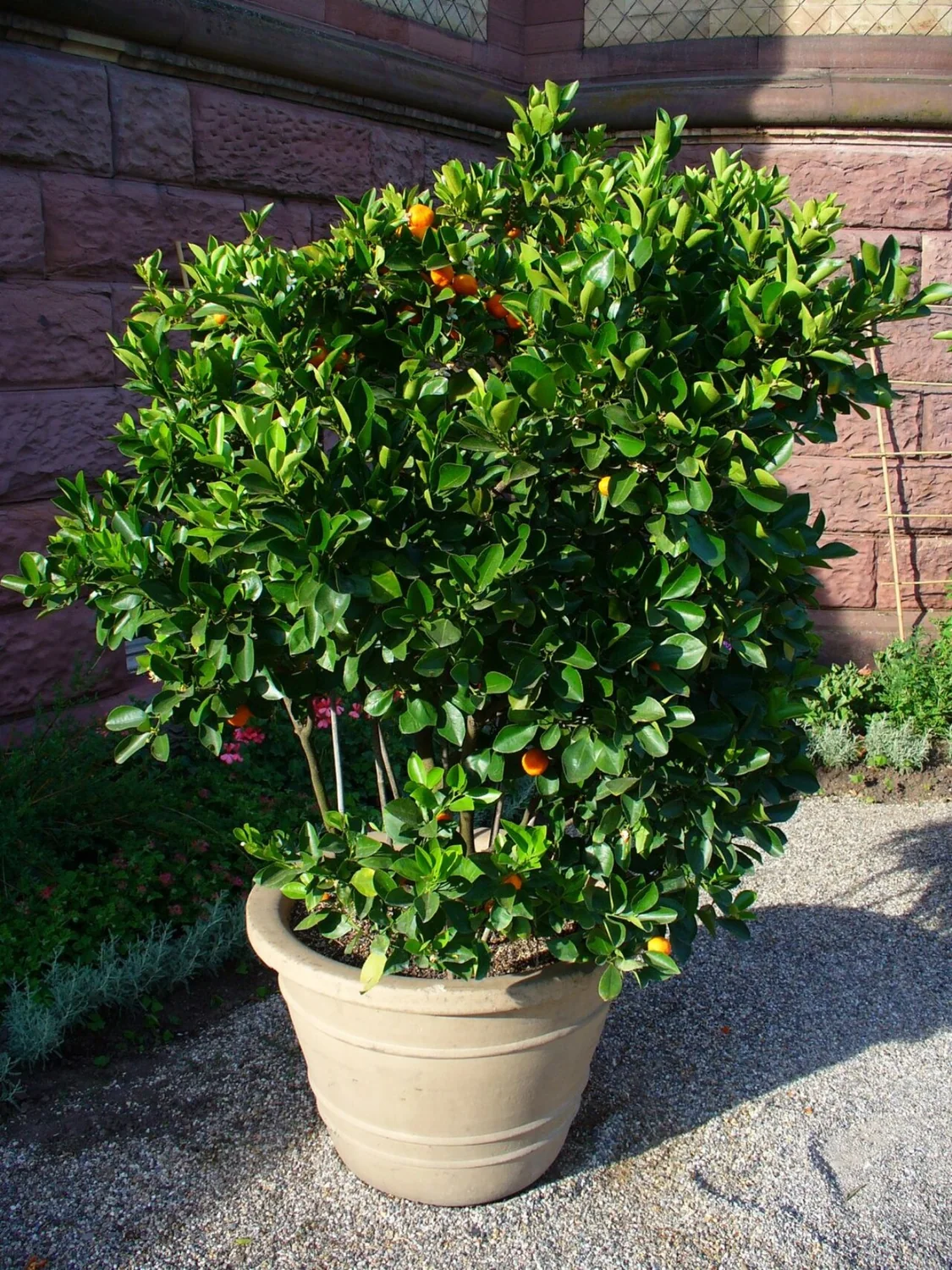
A compact tree with a complicated name
Calamondin is often the most approachable citrus to recognise in a shop: small round fruits sit among glossy leaves on a neatly branched crown. Citrus microcarpa, usually written with a hybrid sign as Citrus × microcarpa, is also called calamansi and appears in older references under Citrofortunella names. Those labels describe the same broad cultivated citrus connection rather than several unrelated houseplants. Its compact presentation is useful indoors, but it does not remove the need for strong light. A tree offered as a gift still needs the sunny position that supported its previous flower and fruit development.
Calamondin combines mandarin and kumquat ancestry and has a long association with cultivation and cooking in Southeast Asia. Its small orange fruit should not be confused with a sweet miniature dessert orange. The sour flavour is part of the crop's identity, not evidence that the tree has been poorly cared for. Buy from a supplier who can distinguish the plant from another small citrus and retain any cultivar and rootstock label. A home grown seedling can be interesting, but a correctly propagated named specimen provides a clearer starting point when the purpose is a compact ornamental tree.
Give the fruiting crown useful daylight
Position the tree close to a sunny window or within a bright conservatory. A dining table set well back from the glass may be an attractive place to photograph the plant but an unsuitable permanent growing site. Check how much of the crown is actually lit through the day. Growth extending toward one side can be balanced by gradual rotation, provided branches and fruits do not catch on curtains. When winter daylight is inadequate, consider a suitable grow light rather than increasing fertilizer. New leaves and flowers need energy that ordinary room lighting does not necessarily supply.
Warm months outside can provide a better growing opportunity where the climate allows. Introduce the plant gradually to direct sun and select a protected location where wind cannot rock the pot. A small fruiting crown can still make an unstable container topple. Inspect the foliage before the autumn return indoors, including the tight spaces around fruit stalks and leaf bases. Keep the move timely rather than waiting for a sudden cold forecast. The tree may continue carrying fruit while its water use changes significantly in the new room, so the summer watering interval should not be carried across without checking.
Make a cover pot easy to empty
Many calamondins arrive in a small production pot hidden inside a decorative ceramic cover. Remove the inner pot periodically so the drainage arrangement can be understood. A container that looks substantial from outside may hold only a narrow root ball. Use an open citrus or similar mix when repotting becomes necessary, maintain the original planting depth, and leave a graft union exposed. Avoid burying the lower stem to conceal a nursery mark. Increase the pot in proportion to the roots, since a large ring of unused wet mix makes care less predictable rather than guaranteeing a larger crop.
Water the occupied root zone thoroughly when it begins to dry enough to need replenishment. Then allow complete drainage before returning the pot to its cover. Do not leave the base in collected water as a way of maintaining humidity. Check deeper than the top layer, especially if the nursery mix and any newer surrounding material have different textures. A warm bright plant can use water rapidly while carrying leaves and fruit. A darker winter room may leave the lower mix wet for much longer, even when the upper surface dries from heating. Let those observations determine the next drink.
Separate a nursery crop from a home crop
A calamondin purchased with many fruits has already completed much of that work under nursery conditions. Its next crop at home may be smaller, later or absent while it adjusts. Enjoy the foliage and blossom without treating each fallen tiny fruit as a failure. A soft clean brush can assist pollen transfer between open flowers indoors. Fruit retention still depends on the tree's resources and environment. Support active growth with an appropriate citrus fertilizer at the instructed rate, allowing for nutrients in fresh potting mix. More concentrated feeding cannot turn a shaded reception counter into a productive growing position.
Prune to retain a reachable balanced crown. Remove confirmed rootstock shoots, broken growth and twigs that create awkward congestion, while preserving enough leafy structure. Repeatedly clipping every new tip into a rigid sphere can interfere with a natural flower cycle. Where a stem carries several fruits, check that it does not rub against glass or bend sharply over the pot edge. Avoid combining a major root disturbance with substantial pruning simply because both jobs are convenient on the same afternoon. Separate changes make the tree's subsequent response easier to interpret and reduce unnecessary interruption of established growth.
Observe the undersides as well as the fruit
The ornamental crop tends to draw attention away from the foliage, where scale, mites or whiteflies may be developing. Look beneath leaves and along sheltered stems during regular checks. Sticky residue and fine stippling are useful signs to investigate, not reasons to apply unrelated supplements. When dust accumulates, clean accessible leaves gently and inspect them as you work. A sudden flush of yellow leaves after relocation calls for examining the light, root moisture and temperature. Keep notes on the move and recent waterings instead of shifting the tree repeatedly between unsuitable positions while searching for an instant visual improvement.
Calamondin can be a good gift for a person who enjoys a small, observable growing project and has the necessary window. Its repeated little fruits lend themselves to a personal message about sharing everyday pleasures or nurturing something over time. Such a message is a design and relationship choice, not a universal cultural promise. If the recipient already knows calamansi as a food ingredient, the plant may carry a particular family connection that should be described in their terms. Avoid assuming that a familiar culinary name makes the tree suitable for every household or office.
The useful things to give with it
Include the botanical label, a clear drainage arrangement and the supplier's information about fruit use and treatments. Ornamental retail fruit should not automatically be served in a drink merely because the species is cultivated as a food crop. Ask who will water the tree during travel, whether branches may obstruct a walkway, and where it will receive winter light. A modest calamondin in a workable pot can be more useful than a larger heavily laden specimen that nobody can move. Settled roots, new leaves and a realistic seasonal routine are the foundation for any later flowers and fruit.