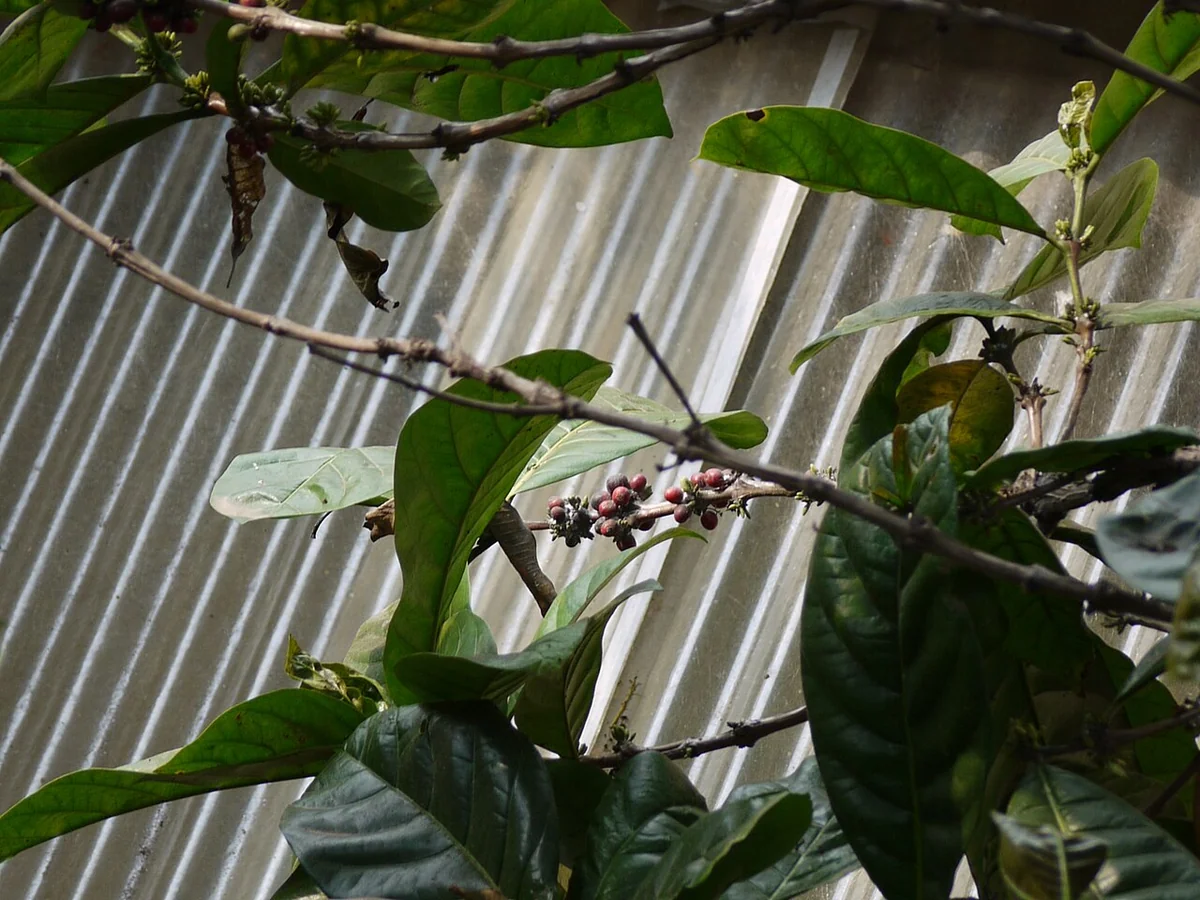
A larger coffee relative for protected culture
Liberian coffee is a larger and less familiar relative of the Arabica tree commonly sold as a houseplant. Coffea liberica is native to western Africa and can develop into a substantial evergreen tree under suitable tropical conditions. Its large leathery leaves have a noticeably textured surface and wavy margins, while mature plants can produce fragrant white flowers and coffee cherries. The species has also been cultivated in parts of Africa and Southeast Asia. An indoor juvenile offers a botanical introduction to that diversity, but it is not an automatically compact desktop substitute for Coffea arabica. A bright spacious protected setting is the more honest starting point.
Identity deserves attention because coffee labels can simplify a complicated group. Liberica, Arabica, and robusta coffee are not interchangeable botanical names, and a retailer's photograph of cherries does not establish the identity of a small leafy plant. Retain reliable provenance and compare the foliage with an authoritative description. Select a specimen with a sound base and active growing tips rather than one valued only for its unusual name. A plant already carrying very large leaves will need considerable room around a window. The small nursery container should not lead the recipient to expect the entire tree to remain at that scale without management.
Light and a workable indoor position
Bright filtered light suits the protected arrangement. NParks notes that Liberian coffee in Singapore performs better in semishade than under full sun, an important reminder that stronger exposure is not always an improvement. Indoors, semishade should still mean substantial useful daylight, not a windowless corner. Introduce any new direct sun gradually and observe the youngest leaves for scorch. A hot enclosed conservatory may need shading and ventilation, while a dim office may be inadequate despite comfortable temperatures. The large blades should remain clear of glass and frequent traffic. Their surface area is part of the decorative appeal but also makes accidental damage conspicuous.
Water, roots, and a draining container
Water to maintain a moderately moist aerated root ball. Check below the surface and irrigate thoroughly when another drink is needed, then remove the excess after drainage. A tree with large leaves can use water rapidly in warm bright conditions, but that does not justify permanently filling a saucer. A larger pot under winter light may remain wet for an extended period. Examine both the original nursery ball and any fresh surrounding mix after repotting, since they can absorb and release water differently. A stable pattern avoids the repeated combination of severe drying followed by prolonged saturation, which is difficult for roots and leaves to tolerate.
Provide a structurally open potting medium with suitable moisture retention and a practical drainage system. Increase container size as roots occupy the available space rather than immediately placing a juvenile in a heavy tub of unused compost. Retain the stem's existing depth and leave room beneath the rim for slow watering. A decorative outer vessel should allow access to the functional inner pot and any collected water. Because the species can become large, plan stability and movement early. A pot that cannot be drained or moved without damaging the canopy is not a thoughtful long term arrangement, even if it initially looks proportionate in a reception area.
Training and ongoing maintenance
Keep temperatures warm and reasonably consistent, with protection from chilly drafts and concentrated dry heating air. Moderate to higher ambient humidity may be useful in a dry interior, but repeated leaf spraying cannot correct a poor root environment or a dark position. Clean the large leaves carefully and inspect the undersides while they are supported. Mites, scale, and mealybugs can occur in protected culture. Feed with restraint during active growth, using an appropriate container product and accounting for nutrients in new mix. A tree that slows in winter should not be pushed with strong fertilizer merely to match its potential growth in a tropical landscape.
Pruning may be necessary to maintain a credible indoor framework. Shorten selected branches while preserving enough foliage and space between them, rather than allowing the tree to become oversized and then cutting it severely during stress. Consider how repeated trimming affects the possibility of flowering. A juvenile should not be expected to carry a mature reproductive display immediately. Fresh seed is used for propagation, but germination and establishment require suitable conditions and reliable material. Processed beverage beans are not a substitute. Keep new plants identified so a collection of different coffee species does not become an unlabelled group whose eventual size and care are uncertain.
Fragrant flowers and cherries can be interesting when they occur, yet neither a regular flowering calendar nor a useful household harvest is guaranteed indoors. The owner should value the foliage and botanical interest even if fruit never develops. If cherries appear, distinguish ornamental growing from food production and understand any pesticides or other products that have been used. Prevent pets and children from chewing leaves or tasting unprocessed material; coffee plants contain compounds that make casual consumption inappropriate. A species being used commercially for a drink does not make every part of a potted specimen suitable for eating or every decorative growing product suitable for food crops.
Coffee culture and a personal message
Liberian coffee can carry a meaningful connection with the diversity of coffee cultivation, especially for someone interested in African plants or Southeast Asian coffee traditions. Those connections should be described accurately rather than presenting one species as a universal symbol of hospitality or commercial success. A giver may personally link it with curiosity, shared conversation, or the pleasure of discovering a less familiar plant behind a familiar beverage. That interpretation does not promise a particular flavour, yield, or benefit. Its real geographical and horticultural story is substantial enough without an invented legend explaining that the tree will bring wealth to an office.
A gift matched to the recipient
This is a specialist gift for a coffee enthusiast who also has appropriate growing space, or for an owner expanding a warm protected botanical collection. A conservatory milestone or a requested birthday plant may fit better than an unannounced desk present. Confirm that the recipient can accommodate large leaves, eventual height, and regular root checks. It is less suitable for a cold home, a dark workplace, or a household where animals investigate every plant. Choose a manageable young specimen with accurate provenance and explain that it differs from a compact Arabica retail plant. Good expectations allow the recipient to appreciate an unusual tree without being burdened by an unrealistic harvest project.