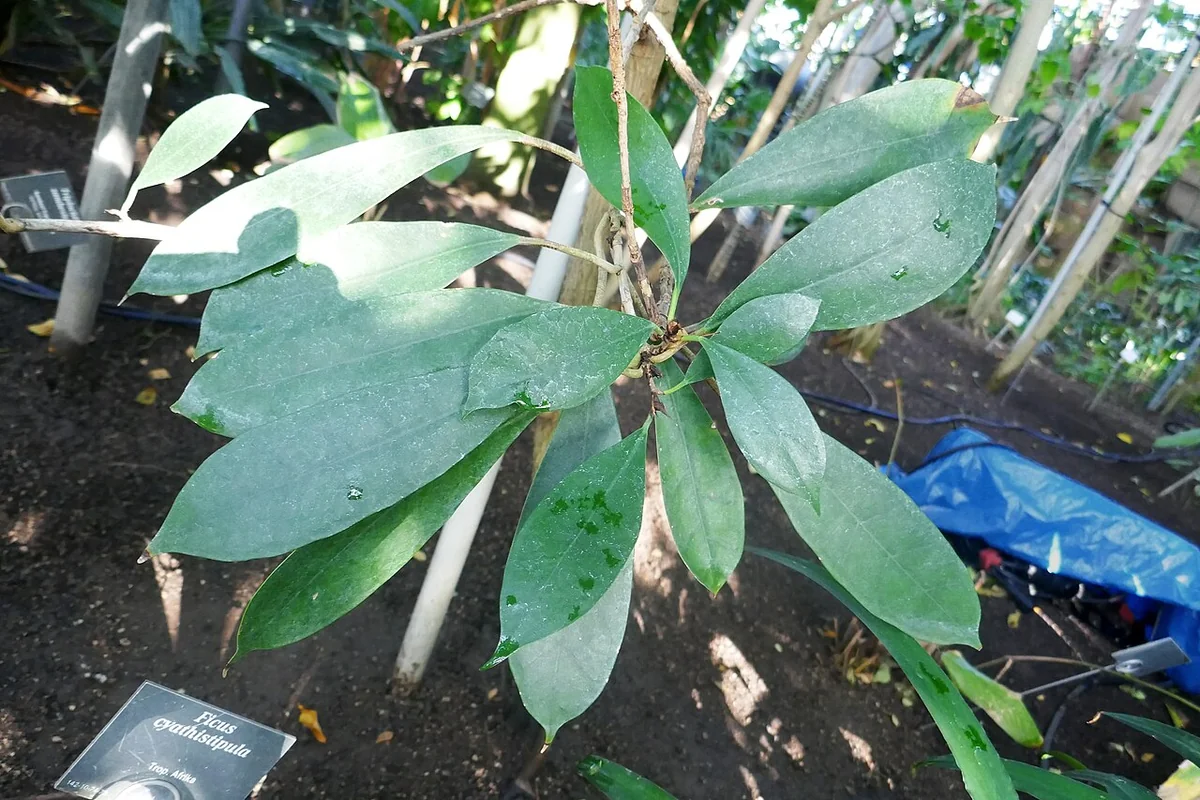
An African forest fig for a protected room
African fig is a useful alternative for someone who likes the substance of a broadleaf tree but wants to explore beyond the most familiar indoor figs. Ficus cyathistipula carries glossy oval to elongated leaves with pointed ends, and the persistent stipules around its growing twigs provide an additional botanical feature. Its natural range is in tropical Africa, including forest and river associated habitats. In the wild it can be a much larger tree or begin life associated with another support. A nursery container limits that scale. The plant is therefore better understood as a cultivated tropical tree than as an intrinsically tiny tabletop species.
Its foliage develops a substantial surface area as the crown fills, so consider width as well as height. A young narrow specimen may eventually place leaves across an adjacent work surface or into a curtain. Leave room for the branch tips to remain exposed to light and for a person to reach the inside of the canopy. Several stems in a pot can produce a fuller immediate display, but they also make lower junctions harder to inspect. Choose a plant with a visible sound base and firm leaf stalks, not one whose decorative wrapping conceals the condition of the lower stems and roots.
Light and a workable indoor position
Bright filtered daylight is a sensible indoor starting point. A tropical forest origin does not mean that a tree can grow indefinitely in the darkest part of a modern room. Place the foliage near a window with a substantial view of the sky, while avoiding an abrupt transfer from nursery shade into fierce afternoon sun. The Royal Horticultural Society treats this fig as a warm protected subject, which is relevant when selecting a conservatory or office. A space that becomes chilly overnight may be unsuitable even when daytime temperatures seem comfortable. Keep the entire plant clear of cold glass and opening exterior doors.
Water, roots, and a draining container
Irrigation should preserve moisture without removing air from the root zone. Feel the upper mix and compare deeper conditions before watering, then moisten the full root ball and let excess drain. The leathery leaves should not be used as a reason to let the pot repeatedly become completely dry. Equally, its association with riverine forest does not justify standing the nursery pot in a tray of water. A plant indoors has a different root environment and much lower water use than a large tree in open ground. Observe how the actual pot dries through several cycles before setting a practical inspection routine.
Use a houseplant mix that remains structurally open after watering. If a compacted older ball is surrounded by new compost, monitor both materials because they may dry at different rates. Move to a larger container only when roots and watering behaviour justify it, and increase the diameter modestly. Top dressing can refresh a small amount of accessible surface mix between necessary repottings, provided no roots or stem tissue are damaged. Keep the crown and trunk base at their previous level. An attractive outer planter can conceal the functional inner pot, but it must not conceal a persistent pool beneath it.
Training and ongoing maintenance
Regular modest maintenance is easier than allowing the tree to outgrow its location and then cutting it severely. Shorten a selected branch to a sound node while preserving enough foliage for the remaining framework. The cuts release milky sap, so gloves and protection for furnishings are appropriate. Semi ripe cuttings can be used by experienced growers under suitable warmth and humidity, but propagation is not a rescue for a root system already failing in wet compost. If a cutting is taken, use clearly identified stock and maintain it separately. The label Ficus cyathistipula should follow the new plant rather than being lost after the first pot change.
Clean a dusty leaf by supporting it and wiping lightly from its base toward the tip. A flexible cloth and plain water usually provide sufficient cleaning. Inspect the underside while the leaf is accessible, particularly around the midrib and petiole. Scale, thrips, mealybugs, and mites are possible indoor pests, and their damage can be confused with general dryness if only the upper surface is examined. Keep an affected new arrival separate from an established collection until its condition is understood. A plant that is clean enough to inspect is easier to manage than one coated with a cosmetic shine product.
Feed conservatively when new growth shows that the tree is using the available light and warmth. Follow the rate for the chosen houseplant fertilizer and reduce feeding as extension slows. Pale leaves can arise from unsuitable moisture, damaged roots, or insufficient light as well as nutrition, so a feeding decision should follow inspection. Changes after delivery deserve patience if the stem is firm and new growth remains promising. A sequence of leaf loss with a wet heavy pot needs more urgent root assessment. Make corrections that address actual observations rather than assigning every brown mark to low humidity or every yellow leaf to hunger.
Meaning without unsupported promises
For this species, a well supported universal gift tradition is not necessary to establish meaning. A giver may connect the tree's tropical forest origins with an interest in biodiversity, or its substantial green crown with shelter and continuity. Those are personal interpretations, and they should be presented that way. The species should not inherit sacred associations belonging to a different African or Asian fig merely because the leaves look similar. Its own botanical identity is part of the attraction. A gift card can name the plant and explain why its form was chosen without promising prosperity, protection, or a particular effect on a person's health.
A gift matched to the recipient
African fig is most appropriate as a gift for an interested plant owner who has bright warm space and welcomes a less usual foliage tree. A new conservatory, a home office with generous glazing, or a personal collection milestone may provide that occasion. Discuss the intended position first, especially if winter temperatures fall sharply after working hours. The latex can irritate skin, and foliage should not be accessible to pets that chew plants. Choose a size the recipient can water and repot without assistance. The value of an uncommon tree lies in a suitable living arrangement and accurate information, rather than in its rarity alone.