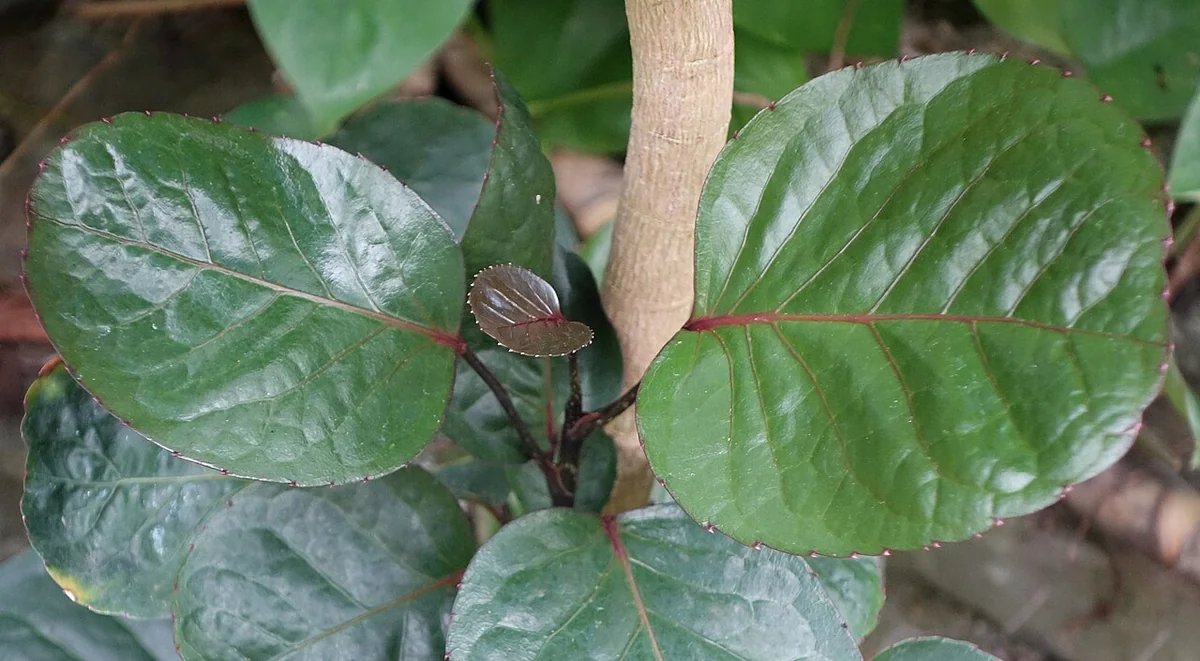
Rounded leaves on a tropical framework
Shield aralia has a very different texture from the finely divided Ming aralia. Polyscias scutellaria produces rounded to kidney shaped leaves or leaflets, often with a shallowly cupped profile, on an upright woody framework. Selections sold as Fabian, Balfour aralia, or related variegated forms can look distinct, so the retail name and the botanical identity should be recorded together. The species has a long history of cultivation in tropical Asia and the Pacific, and references differ in the precision of its original range. That uncertainty is worth retaining rather than turning a widely cultivated ornamental into a tree with an invented exact birthplace.
Choose a plant whose form suits the intended display. A stout stem supporting several rounded clusters gives a more tree like outline, while multiple stems create a fuller shrub. Look beneath the attractive upper leaves for clean branch junctions, live lower growth, and a firm base. Old ties, surface stones, or decorative wrapping should not prevent inspection. Variegated plants may need more useful daylight than an all green specimen to maintain satisfactory growth. A dark purple underside or naturally curved blade should not be confused with disease without checking the particular selection. Knowledge of the starting appearance makes later changes easier to assess.
Light and a workable indoor position
Bright indirect light provides a sensible indoor foundation. Landscape records showing full sun in a tropical garden describe plants acclimated to outdoor conditions, not the immediate needs of nursery stock transferred through a shop. Introduce stronger light gradually and watch the newest leaves for damage. A position near a window should illuminate more than one side of the crown. If the tree becomes one sided, adjust the arrangement or turn it in small increments rather than continually cutting the brighter side back. Low light can slow growth substantially and reduce the capacity to rebuild a pruned framework, even while the old thick leaves remain temporarily attractive.
Water, roots, and a draining container
Check the mix before watering and permit some surface drying without letting the whole root ball become a hard dry block. Irrigate thoroughly when needed and let water leave the base. Empty a cover pot instead of allowing the lower roots to remain in a collected pool. Rounded substantial leaves do not mean that the stem base can tolerate continuous saturation. A plant in a cool room may use water slowly, while active growth under brighter warm conditions changes the interval. If a single stem in a grouped planting begins to soften, inspect it separately; the good appearance of neighbouring stems does not rule out a local root problem.
Use a container mix that retains moisture while keeping air spaces around the roots. A moderate repot is appropriate when the existing root system has filled its container or the watering pattern has become unstable. Preserve the established stem depth and avoid covering old trunk tissue with fresh compost. The plant is often displayed in a pot chosen for visual weight, but a stable decorative cover can be separate from the functional inner container. That arrangement makes drainage and root inspection easier. Leave enough space between the two pots to remove the inner one without pulling hard on the woody stems or damaging the rounded foliage.
Training and ongoing maintenance
Temperature stability is a practical priority for a tropical aralia. Avoid cold entryways, drafts from open winter windows, and the immediate flow of conditioned air. A heating vent can dry foliage while the shaded pot below remains wet, producing misleading symptoms. If room humidity is persistently low, change the ambient arrangement rather than repeatedly coating the leaves with water. The thick blades can be cleaned gently with a damp cloth, supporting their cupped shape instead of forcing them flat. During cleaning, check the undersides, stems, and central junctions for insects. A compact canopy can conceal a developing pest population until leaves begin to fall.
Prune to preserve a useful relationship between trunk and crown. Shorten an overlong branch above living growth and allow the response to develop before making another major change. Avoid cutting an already sparse weak plant into a bare sculptural trunk with the expectation that it must immediately branch everywhere. Stem cuttings are a recognized propagation route, but they need suitable tissue and controlled moisture rather than a leaf floating in a decorative bowl. Keep the source plant's identity with any cutting, especially when several different aralias are present. Do not treat a common family resemblance as proof that every form has the same growth habit.
Feed while there is active growth and enough light for the plant to use the nutrients. Follow the product's houseplant instructions and consider what was added to fresh mix at potting. A slowly growing indoor aralia usually requires less intervention than an actively growing tropical hedge. Look for scale, mealybugs, and mite damage during normal inspection, and investigate the precise cause before applying a treatment. Yellow leaves above wet compost point toward a different problem from dry crisp margins after a missed watering. Record significant moves or cold exposure, because a delayed response can otherwise be mistaken for a new nutritional issue.
Meaning without unsupported promises
The rounded leaves can be given a personal meaning of shelter, continuity, or a gathered household, but that interpretation should not be presented as a universal custom. The species has documented roles as an ornamental hedge and container plant in tropical cultivation. Particular regional uses deserve their own sources and context, rather than being generalized into medicinal or luck claims for an office tree. A modern gift can celebrate the recipient's appreciation of strong shapes and smaller details. The choice of a plant with rounded leaves is meaningful because of the relationship and the message, not because the leaves guarantee a specific future outcome.
A gift matched to the recipient
Shield aralia can suit a new home, a personal office, or a milestone for someone who enjoys carefully maintained indoor trees. A compact specimen may be more appropriate than a tall expensive trunk if the available window area is limited. Confirm that the recipient has a warm position and can check root moisture consistently. Treat the foliage as ornamental and consider pets or children who may investigate fallen leaves or pot decorations. A label explaining the species and the particular selection prevents later confusion with other aralias. Deliver a practical living plant, not an elaborate arrangement whose hidden drainage makes routine care unnecessarily difficult.