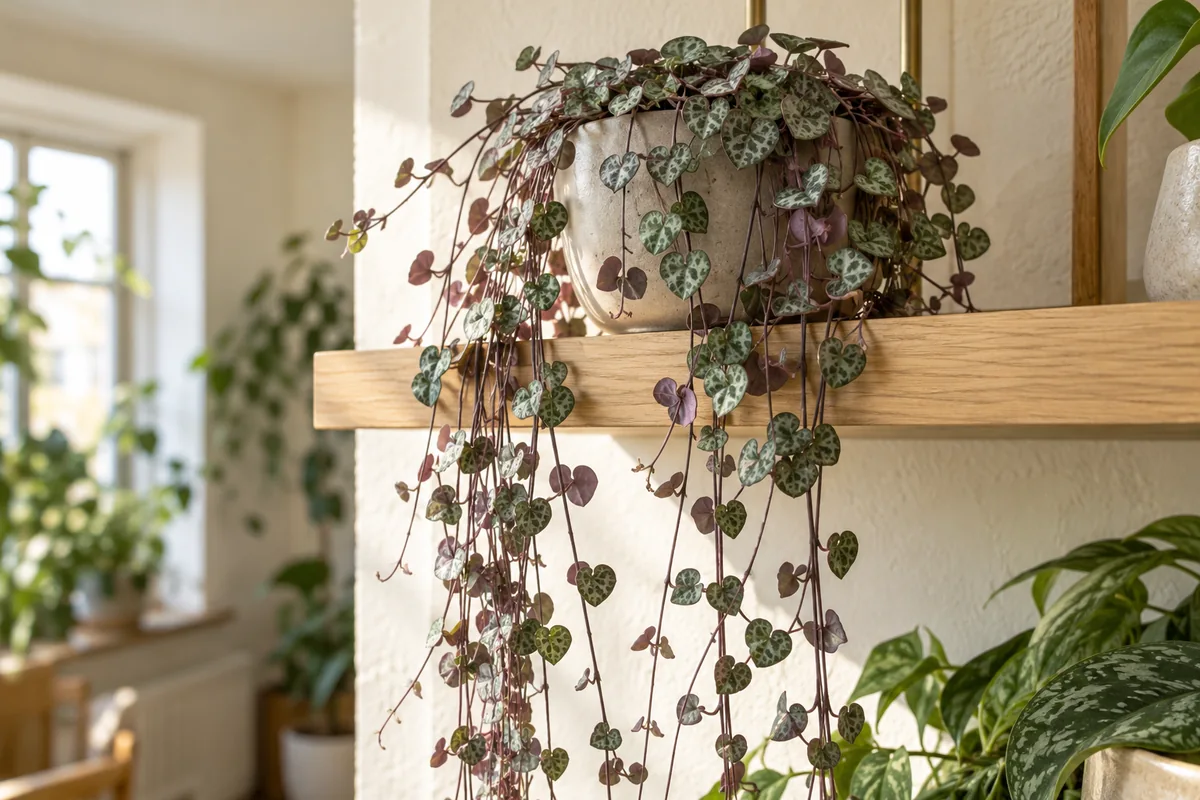
A long string of hearts vine often has more useful growing points than its sparse appearance suggests. Each pair of leaves marks a node, and those nodes can be held against a suitable growing medium to encourage roots. This makes layering a practical way to fill the top of a pot instead of producing another single strand hanging from the edge. You can work with a vine that remains attached to its parent or with a detached section. Leaving it attached provides support from the established plant while roots develop. Choose a firm vine carrying sound leaves, and untangle it gently before you decide where it should sit.
Prepare a shallow, small container with drainage holes and a fine textured, airy mix suitable for young succulent vines. Large bark pieces make it difficult to keep tiny nodes in contact with the surface. A modest amount of potting material combined with fine perlite or grit is easier to arrange. Moisten the mix and let it drain before positioning the vine. It should feel lightly damp rather than sticky or saturated. If you are filling the original pot, check that its existing mix is still open and usable. Layering onto compacted, persistently wet soil creates a poor foundation, regardless of how carefully you place the new stems.
Lay a section of vine in a loose curve across the surface, with the nodes touching the mix and the leaves resting above it. Do not pull the stem tight between points. Small bent wire pins can hold the vine gently, provided they do not pierce or crush it. A clean plastic support serves the same purpose. Keep some space between neighboring leaves so they can dry after watering and remain easy to inspect. Several nodes in one small pot can create a fuller result than one long cutting tucked deeply into the center. The aim is reliable contact at the nodes, not burial of the whole vine.
When using detached pieces, make clean cuts between the nodes and retain enough stem to handle each piece without gripping its leaves. Very short pieces are possible, but they dry quickly and are harder to position accurately. A section with a few nodes gives more options for anchoring. If a stem has a firm aerial tuber, that structure may also be positioned at the surface where it can form roots. Do not cut up every available vine at once. Keep part of the parent plant intact so you can compare its response and retain established growth if some of the small pieces fail to take.
Set the container in bright indirect light. String of hearts needs useful light to make compact growth, yet a tiny propagation pot can dry or overheat quickly in strong afternoon sun. Check the surface frequently at first and add small amounts of water when it is losing its slight moisture. Roots need oxygen as well as water, so avoid leaving the container in a filled saucer. A cover can make the setup easier to keep moist in a dry room, but persistent condensation and wet leaves are warnings to ventilate. Unlike a tropical fern spore container, this is not a project that needs continuously saturated air and soil.
Watch the nodes rather than repeatedly lifting the entire vine. New roots may be visible at the surface, and fresh growth at a node often follows. A gentle inspection of one outer node is less disruptive than checking every pin every few days. Rooting is slower when the room is cool or the parent vine is not growing actively. A leaf becoming slightly less firm does not automatically mean the cutting needs more water; examine the medium first. Remove any detached piece that becomes soft and discolored so it does not remain pressed against neighboring stems. Keep the rest of the setup stable while the firm pieces continue developing.
An attached layer can be separated after several nodes have rooted well enough to anchor their own section and support new growth. Cut the connecting vine between the established parent and the newly rooted portion, leaving the new roots undisturbed. If the layering has filled the original pot, there may be no reason to separate it at all. Allow the new strands to grow from their anchored positions. Gradually let the surface become a little drier between waterings as the roots establish. The change should follow the plant and the size of the pot, not a sudden switch to the driest treatment you use for a mature succulent.
Keep the young planting in its small container until roots have made use of the space. Moving it into a much larger pot can turn a simple propagation into a moisture management problem. As new vines lengthen, guide one or two across the top again if you want more coverage, leaving the rest to trail naturally. A pot filled with several independently rooted points is easier to maintain than a dense knot of unrooted stems. Note which nodes rooted, how the surface dried, and whether an attached layer worked better in your room. These observations help you repeat the method without assuming that every vine will respond on the same timetable.