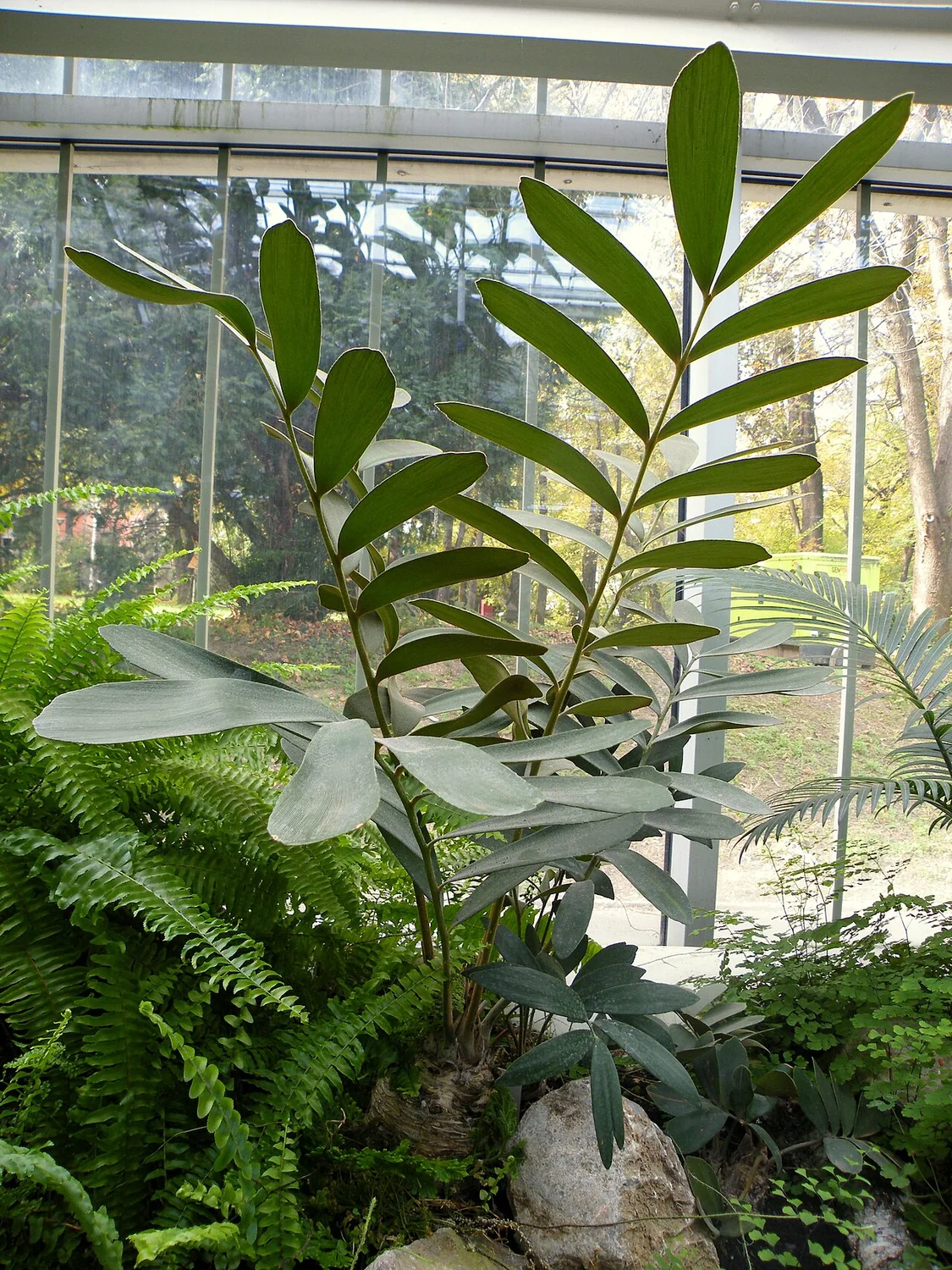
The Mexican Cycad behind Cardboard Leaves
Cardboard cycad has a tactile-looking canopy that immediately separates it from soft indoor palms. Zamia furfuracea carries stiff, broad leaflets with a firm, slightly fuzzy texture, arranged on substantial leaves rising from a short thickened base. It is a cycad, not a true palm, and it belongs to a different seed-plant lineage from flowering indoor trees. A young pot can have a strong sculptural outline without much height. That compact appearance should not encourage casual gifting. The plant is toxic if eaten, so household access by animals and small children is a primary selection issue rather than an afterthought once the display is installed.
The species is native to Mexico, where its dryland and coastal associations help explain its robust foliage and tolerance of drying intervals. Its epithet refers to the scaly covering that contributes to the textured appearance of young growth. A nursery-grown container plant should be obtained from a dependable source, not chosen because it resembles an unusual wild-collected curiosity. The plant's relationship with an ancient lineage can be discussed without claiming that the modern species itself has remained unchanged since the dinosaurs. A clear botanical label provides a more useful beginning than a generic tag combining the words palm, fern, and prehistoric decoration.
A Bright Position with Controlled Access
Provide strong indoor light, introducing appropriate direct sun gradually after nursery shade. A bright conservatory or sunny room is a better setting than a dim office corridor. Its leaves can be broader and more horizontal than the small pot suggests, so allow a real radius around the base. The firm leaflet ends may be uncomfortable where people brush past. A display at the edge of a meeting table or near a child's play area is unsuitable for both physical and ingestion reasons. Evaluate the actual route through the room rather than assuming a slow-growing plant cannot create an immediate placement problem.
Allow the medium to dry between thorough waterings. The broad, tough foliage is not a sign that the plant needs constant tropical moisture. In a cool quiet season, the interval may be long, while active growth and brighter conditions increase demand. Check the root ball itself and do not rely solely on the appearance of a gravel top layer. Surplus water should leave the pot completely. If a cover is used, remove the collected runoff rather than letting the base remain wet. A dormant-looking period with firm tissue is different from a soft, deteriorating root system that has been repeatedly soaked.
An Open Root Zone and Slow Leaf Renewal
Choose a sandy, open container medium and a draining vessel appropriate to the occupied roots. A modest root system can be endangered by too much permanently damp compost in an oversized planter. Keep the thickened base at its original level. Repot with care and use suitable hand protection where rigid leaves or plant material are handled. The attractive crown does not need to be dismantled to refresh the pot. Preserve sound roots, settle the medium without excessive compression, and allow an accessible margin for inspection. A plant that can be checked safely is easier to maintain than one fixed permanently inside an inaccessible ornamental installation.
Growth can be episodic and slow. New leaves may arrive as a distinct flush and then harden into the characteristic cardboard texture. Protect that soft stage from physical knocks and abrupt changes in sun. A leaf formed weakly in low light does not become ideally proportioned after it hardens, so a suitable position should be established before expecting the next flush. Avoid forcing a response with strong repeated fertilizer. Use an appropriate product moderately during active growth and follow its label. The plant's natural pace is part of its identity, not evidence that it needs more water and feed every week.
Rigid Leaves, Cones, and Safe Household Cleanup
Old leaves should be removed only when they are genuinely spent or a specific problem warrants it. Retain green working foliage even if its outline is not perfectly symmetrical. Cutting every leaf back to the boundary of a small shelf creates damaged ends without changing the habit of future growth. Never cut into the central growing area to reduce height. Dust can be removed gently while a leaf is supported. Inspect the leaflet undersides and the sheltered base for scale and other pests, particularly after a new purchase. A rigid glossy canopy can conceal an infestation long enough for it to become difficult to manage.
Mature plants may produce cones, with male and female structures on separate individuals. The red seeds associated with female cones can be visually attractive, but they must not be treated as edible decorative berries or left where animals can collect them. All cycad material should be managed with the plant's toxicity in mind. Remove fallen debris safely and keep it out of casual reach. If ingestion is suspected, seek professional advice promptly rather than experimenting with a home remedy. The purpose of including this caution in an ornamental guide is to support an informed plant choice, not to provide medical treatment instructions.
Sculptural Foliage Is an Agreed Commitment
Cardboard cycad can be an agreed gift for an experienced collector who appreciates sculptural foliage and has a bright, controlled setting. Its durable-looking leaves might personally suggest constancy or careful preparation, but there is no need to invent a fixed cultural symbolism or a promise of resilience for the recipient. Discuss the toxic nature and future spread before purchase. It is a poor surprise for a family with curious pets or toddlers. A smaller, responsibly sourced specimen with a clear botanical label and an honest care note is more considerate than a dramatic plant whose household constraints have been omitted for the sake of presentation.
Over time, follow the condition of new leaves and the firmness of the base rather than demanding constant visible activity. Keep roots aerated, adapt watering to the season, and allow enough space for each flush to harden without damage. If the plant outgrows its initial stand, relocate it before repeated collisions spoil the foliage. Zamia furfuracea can provide a distinctive architectural element indoors, but its success depends on a suitable home as much as on a watering technique. The right display respects a Mexican cycad's pace, structural needs, and toxicity, while allowing its particular leaf texture to remain the center of attention.