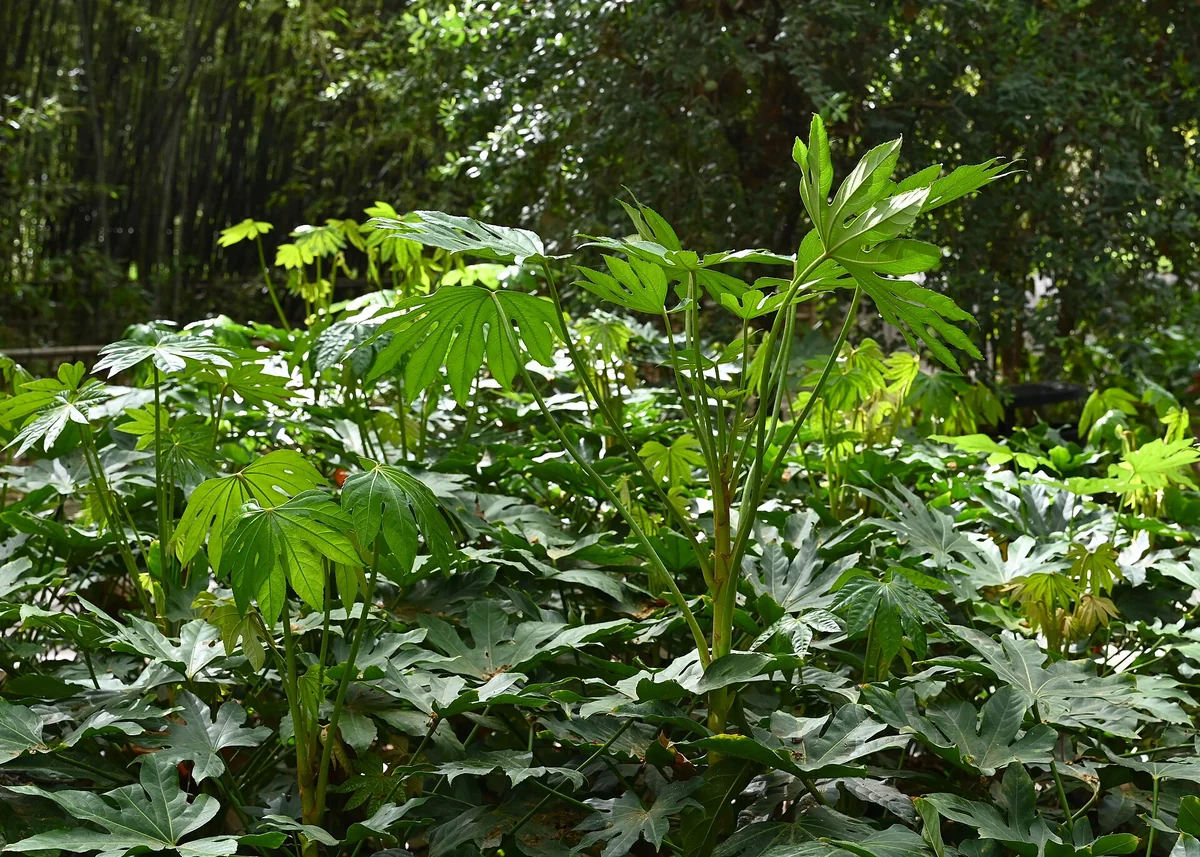
Tropical looking leaves for a cooler room
Japanese aralia creates a tropical looking canopy with large glossy leaves divided into deep lobes, yet it is often more comfortable in a cool bright room than among heat demanding tropical trees. Fatsia japonica is native to East Asia, particularly Japan and Korea, and develops as a substantial evergreen shrub or small tree. The broad leaves are its main indoor attraction. Their handlike outline is visually strong even on a relatively young plant, so a pot that seems modest at the nursery can quickly claim considerable room. Choose it for an appropriate protected environment rather than assuming tropical appearance always means high indoor temperatures and intense sun.
The species is familiar in outdoor shade planting as well as conservatories and homes. That dual use explains why a retail label may provide garden dimensions that look surprising beside a small indoor pot. Compact named selections can be more suitable where space is limited, but they still require enough room for their broad blades. Variegated forms have different patterns that should be recorded at purchase rather than later mistaken for damage. Inspect the stem base, the newest developing leaf, and the underside of older leaves. A dense crown should not prevent the roots and lower framework from being assessed before the plant is selected.
A bright cool growing place
Bright indirect daylight and a cooler well ventilated position provide a useful indoor starting point. The Royal Horticultural Society specifically recognizes cool bright indoor culture, which distinguishes this plant from a tree that needs a constantly hot conservatory. Harsh sun against glass can damage foliage that developed in shade. A sheltered east exposure or another bright position without severe afternoon heat can be practical. Deep darkness still limits growth, even though the species is used in shaded gardens. Observe leaf size, stem strength, and the persistence of lower foliage rather than assuming every indoor location offers the equivalent of outdoor shade.
Water, roots, and a draining container
Keep the roots moderately moist while allowing free drainage and some upper layer drying. Check below the surface before irrigation, then moisten the whole root ball when needed. A large leaf can lose water quickly during a warm spell, but a cool shaded pot may remain wet for much longer. Empty the tray or outer cover after drainage. Established garden tolerance of dry conditions should not be treated as permission to abandon a newly rooted indoor specimen until it collapses. At the same time, a root ball left continuously saturated can decline even if the room itself is cool. The actual drying pattern determines the workable interval.
Use a container mix with both moisture retention and stable air spaces. When roots have filled the available space, repot moderately and retain the established level of the stems. A heavy broad planter helps balance the wide crown, but it need not contain an unnecessarily large unused volume of wet compost. A functional inner pot can be stabilized inside a larger cover if drainage remains accessible. Leave the stem base visible instead of covering it with decorative material. If the tree becomes too large to move conveniently, arrange a safe way to reach and empty the drainage tray before routine care becomes difficult or the pot is damaged.
Training and ongoing maintenance
Prune in relation to the desired framework. A selected tall stem can be reduced to useful growth, or older stems may be managed to encourage a more balanced plant, but the response depends on light and current vigour. Avoid cutting a weak specimen severely while its roots are already struggling. Large leaves can be damaged while moving the tree, so support the pot and keep the canopy clear of door frames. The handlike blades do not fold neatly through a narrow gap without injury. A smaller compact selection may be a more sensible long term choice than repeatedly forcing a vigorous plant to fit an unsuitable room.
Clean the glossy leaves by supporting them and wiping gently with a damp cloth. Dust removal also exposes the leaf undersides and stalk junctions for inspection. Aphids, mealybugs, scale, thrips, or mites can occur indoors even when outdoor plants nearby seem trouble free. A damaged young leaf may have several causes, so look for an actual pest or a clear exposure event before treatment. Feed regularly enough to support active growth according to the product's instructions, then ease feeding during a quiet winter period. A plant in a cool dim room should not be pushed with fertilizer to imitate growth in a bright sheltered garden.
The flowers of established plants appear as pale rounded clusters in a branching display, followed by dark fruit where conditions permit. Indoors those features are not guaranteed, and their absence does not negate the foliage tree. Do not apply repeated bloom products merely to reproduce a photograph of a mature outdoor plant. Keep fruit or cut material out of casual reach of children and pets, and treat the tree as ornamental rather than a food source. If a summer move outside is planned, choose shelter from harsh sun and drying wind and allow an adjustment period. A shaded patio can still expose the leaves to much stronger light than the room they came from.
Meaning without unsupported promises
The species' Japanese and Korean origin provides geographical context, while its long use in gardens explains its place in architectural planting. Specific cultural meanings should not be inferred automatically from the word Japanese. A giver may personally associate the broad open leaf with welcome, a generous space, or the start of a home, clearly presenting that as a chosen interpretation. The genuine contrast between a tropical appearance and preference for cooler protected conditions can also interest someone who enjoys learning about plants. There is no need to promise luck, protection, or a health effect to justify its role as an attractive living gift.
A gift matched to the recipient
Japanese aralia can suit a housewarming where a cool bright entrance room or conservatory is available, or a requested plant for someone who enjoys broad foliage. It is less suitable for a hot dim office or a narrow apartment where every passing person would brush the leaves. Confirm the eventual width and the recipient's ability to reach the pot for thorough watering. A compact labelled selection may provide a better fit than a large ordinary species plant. Include its previous growing conditions and explain that shade tolerance is not the same as thriving in darkness. The thoughtful choice is one that respects the room's climate as well as the owner's taste.