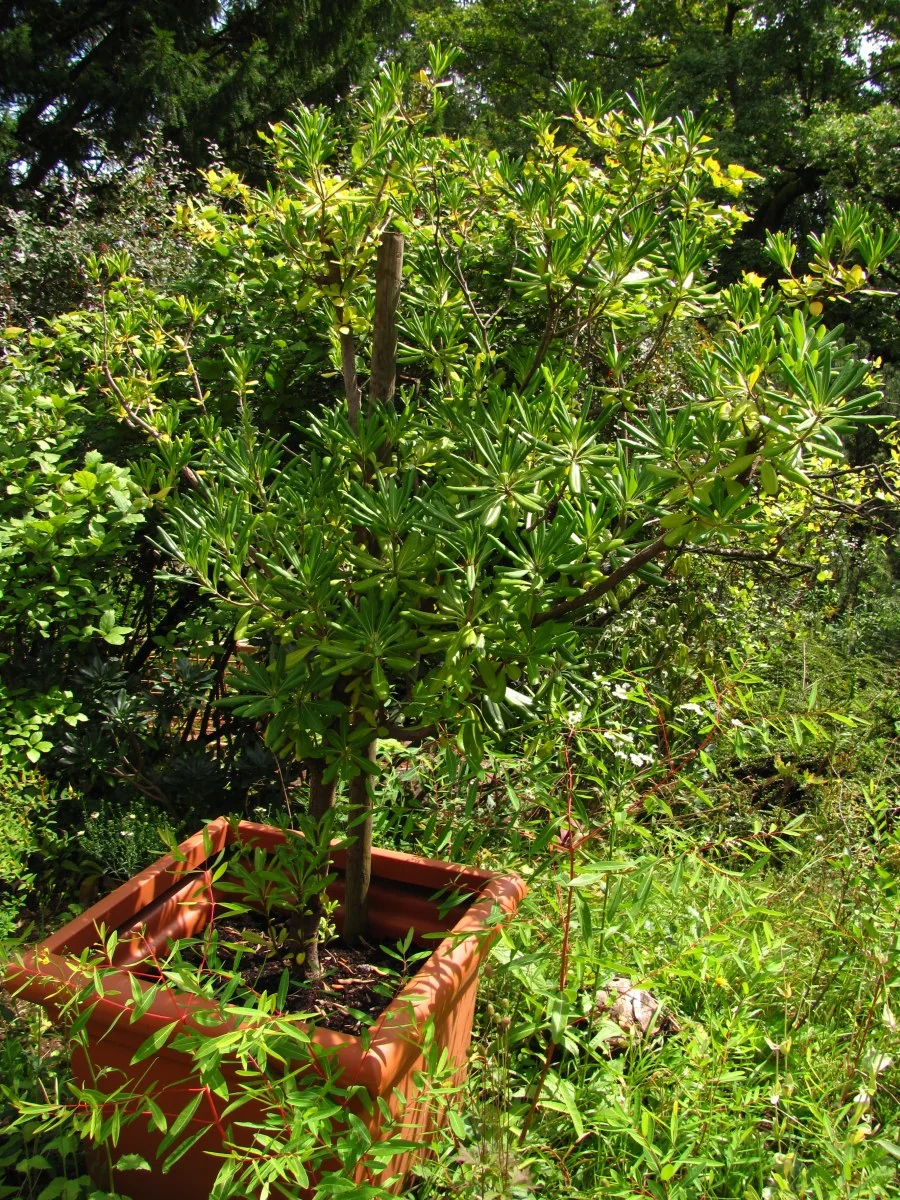
A fragrant conservatory shrub with tree potential
Japanese mock orange is a dense evergreen shrub that can be trained into a small tree and grown in a substantial container. Pittosporum tobira is native to parts of East Asia, including China, Korea, and Japan, and is familiar in warm coastal landscapes elsewhere. Its leathery leaves cluster toward the ends of branches, while suitable mature plants can produce small fragrant pale flowers. The common name refers to a fragrance resemblance; this is not a citrus tree. For indoor use the most credible setting is a bright cool conservatory or protected glazed space. It should not be advertised as an interchangeable substitute for tropical foliage trees in a dim heated office.
Selection makes a major difference. The ordinary species can become a large rounded shrub, while compact forms such as Nanum have a different scale and usually a shrubbier outline. A variegated form adds pale leaf margins but still needs enough useful light. Examine the label and the existing branch structure rather than assuming a young plant's height predicts its final dimensions. A trained standard can provide a clear trunk beneath the crown, but the canopy still needs space and ongoing shaping. Look for living tips and a sound base, and make sure the functional container can be inspected beneath any decorative outer wrapping.
A bright cool growing place
Provide abundant daylight, introducing stronger direct exposure gradually if the plant has come from shade. A cool bright room can be much more suitable than a warm dark one, because light and growth must remain in a workable relationship. During winter, assess the minimum temperature beside the glass and protect the pot from severe freezing, especially where the roots are exposed above ground in a container. Outdoor hardiness descriptions do not transfer perfectly to a small pot. Equally, an overheated interior can encourage soft growth under inadequate light. Choose the year round position with seasonal conditions in mind rather than moving the plant repeatedly for decoration.
Water, roots, and a draining container
Water after inspecting moisture at the root ball. Allow some surface drying between thorough irrigations while avoiding repeated severe drought in a restricted pot. A young recently planted specimen needs closer checks than a well established landscape shrub. Apply water through the full root zone and allow surplus to escape. Empty a cover or saucer before the lower roots remain submerged. In a cool winter conservatory, moisture can persist much longer than during a bright warm growing period. Reducing frequency from observation is more sensible than continuing an outdoor summer schedule simply because the plant retains its evergreen leaves.
Use a draining container medium with enough stable structure to resist compaction. A substantial specimen benefits from a pot whose width and weight balance the crown, yet a very large unused volume of wet compost is not the best way to obtain that stability. A heavier outer vessel can hold a correctly sized inner pot. Repot when roots occupy the current space or the mix no longer drains and wets predictably, increasing size moderately. Keep the trunk base at its established depth. Leave clearance for slow watering below the rim and retain access to the drainage tray before the tree becomes too heavy to handle easily.
Training and ongoing maintenance
Pruning depends on whether flowers or a clipped outline are the priority. Repeated shearing of branch tips can remove the growth that would have carried a flower display, so a flowering plant should be assessed before it is reduced merely for symmetry. Selective trimming after an appropriate display can preserve more natural clusters of foliage. Avoid cutting a weak shaded tree hard with the expectation of instant density. A compact selection may need less intervention than a vigorous standard. Clean tools and remove cut material from the pot, and check any support ties so thickening bark is not marked beneath an increasingly full crown.
Indoor flowering is a possibility under suitable maturity and conditions, not a guaranteed annual event. Fragrance can be part of the attraction when flowers are present, but a gift should not depend on a bloom schedule copied from a garden in another climate. Do not repeatedly increase bloom fertilizer to compensate for inadequate light or excessive winter warmth. Feed at the product's appropriate container rate when the plant is growing actively, taking account of nutrients already in fresh mix. If foliage remains sound but flowers are absent, review pruning history and the seasonal environment before treating the plant as unhealthy or deficient.
Inspect the crowded leaf clusters for scale, mealybugs, mites, and other pests appropriate to the growing region. A sticky surface, distorted new leaves, or a localized colony calls for identification rather than an automatic watering change. Dust can be wiped from the tough blades while supporting the twig. General yellowing above a persistently wet pot suggests a different investigation from isolated scorch after a sunny move. Fruit and seeds, if produced, belong to an ornamental display rather than a household snack. Keep them and pruning debris out of reach of children or pets that investigate plants, and avoid assuming that a citrus sounding common name establishes edibility.
Meaning without unsupported promises
Its East Asian origin and long ornamental use can provide accurate context for a gift, but the name alone does not establish a universal ceremonial meaning. A giver might personally connect the compact evergreen crown with a welcoming threshold or a calm structured space. That is a design interpretation, not a promise of luck. The genuine contrast between glossy leaves and an occasional fragrant flower display may appeal to someone who enjoys seasonal observation. Avoid attaching the symbolism of true orange blossom to this unrelated plant without making the distinction clear. Botanical accuracy can coexist with a warm personal message rather than limiting it.
A gift matched to the recipient
Japanese mock orange is most suitable for a recipient with a bright protected porch, a cool conservatory, or an established container collection. It can mark a housewarming in a suitable property or a requested addition to a seasonal growing space. It is less considerate as an unexpected office tree where the room is warm, dim, and difficult to ventilate. Confirm the eventual size and whether flowers or a clipped form are wanted before selecting the cultivar. Deliver it with its proper name, an accessible draining pot, and an account of its recent conditions. The best gift choice is the one that fits the recipient's actual room rather than its scent in a nursery.