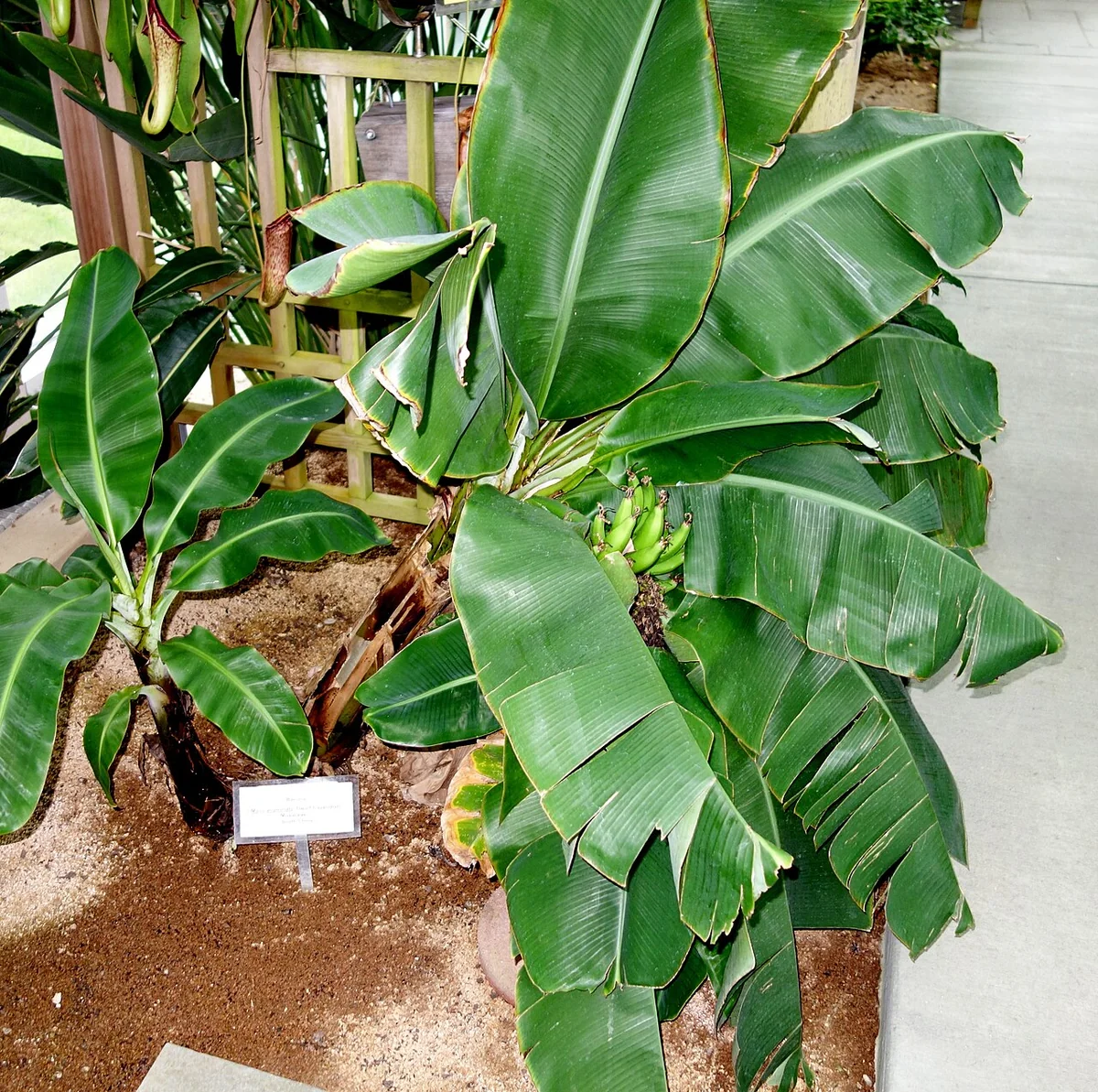
A Dwarf Selection Is Still a Large Herb
A dwarf banana can make an indoor space feel dramatically green, but the name describes selected cultivated forms rather than every plant of Musa acuminata. Wild plants and different cultivars vary greatly in size and fruit characteristics. Even a relatively compact selection carries substantial leaves and can outgrow a casual desktop position quickly. The apparent trunk is a pseudostem made from overlapping leaf bases, not a woody tree trunk. New shoots arise from the underground growing system. That structure determines maintenance and renewal, so a banana should be understood as a large architectural herb rather than a palm that can be clipped into a permanent small crown.
Musa acuminata originates in the broader Southeast Asian and Australasian region and is important in the ancestry of many cultivated bananas. The history of cultivation is complex, involving selected forms and hybrids rather than a single uniform wild fruit tree. A nursery plant sold as Dwarf Cavendish should carry that cultivar identity if it is to be discussed specifically. The botanical species name alone does not establish that exact form or promise familiar edible fruit. For an indoor foliage display, the most useful buying information is mature size, proven cultivar identity, and the conditions needed to support large leaves over the long term.
A Bright Growing Space and Reliable Water
Light is a major commitment. Choose a very bright conservatory, sunroom, or suitably lit atrium rather than a shaded ordinary office. Introduce direct sun progressively when the plant has been grown under shade. A large leaf can scorch after a sudden exposure change even though the species generally requires strong light for vigorous growth. Consider the path of the next emerging leaf and the eventual leaf span. Low ceilings, hanging lights, and curtains can obstruct expansion. A spectacular pot placed temporarily for an event is not necessarily evidence that the same location can support it as a permanent living installation.
Active banana growth requires a dependable water supply. Keep the root ball evenly moist without leaving it oxygen-starved in standing water. Large leaves can use moisture rapidly in warmth and bright light, so a small container may need frequent checking. In a cooler or dimmer period, reduce watering to match slower demand rather than continuing a summer volume automatically. Feel the actual medium and inspect drainage. A hidden lower reservoir in a cover pot is not an appropriate substitute for attentive watering. Likewise, repeated little splashes may leave the central root ball dry even when the surface looks newly damp.
Root Volume, Warmth, and Pseudostem Renewal
Use a fertile, open container mix and enough root volume to support the expected growth. A vigorously growing banana can require repotting sooner than slower architectural plants nearby, but a small plant still should not be placed immediately into a huge stagnant tub. Preserve the growing base at its appropriate level and support the root mass during a move. A sturdy, broad-based container helps balance the canopy. Plan how the pot will be shifted for cleaning, drainage, or seasonal relocation. A wheeled platform must be stable and suitable for the weight, with a clear route that does not force broad leaves through a narrow doorway.
Warmth and humidity influence leaf quality. A banana in a dry heated room may develop marked edges, while a cold draft can interrupt growth sharply. The relevant conditions are those around the foliage and roots, not merely the average temperature at a wall thermostat. If humidity is managed, use a method appropriate to the whole room and maintain ventilation. Repeated misting alone does not solve a permanently dry microclimate or a failing root system. Strong moving air can shred leaves. Some splitting is normal and need not be treated as a nutrient deficiency, but repeated physical damage can make a crowded indoor display look increasingly worn.
Feeding Active Growth and Understanding Pseudostem Renewal
Feeding should accompany genuine growth, using a suitable labelled fertilizer and accounting for nutrients already in fresh medium. A fast-growing banana can use more resources than a slow dracaena, yet strong fertilizer cannot compensate for low light. Watch the size, strength, and spacing of new leaves. An old outer leaf retiring as another opens is not the same as several new leaves collapsing. Clean dust from the broad blades with support under the surface. Never pull apart a rolled emerging leaf to speed its opening. That delicate stage should be allowed to unfold without a caretaker trying to impose a display-ready shape.
Understand renewal before pruning. A pseudostem is not a conventional woody trunk that can be shortened and expected to branch at the cut. Mature fruiting stems complete their cycle while replacement shoots continue from below, but an indoor foliage specimen may never reach the conditions needed for a reliable fruit crop. Remove a completely spent leaf stalk carefully and avoid injuring the central emerging growth. Manage surplus shoots thoughtfully if a clump becomes crowded. Separation requires a viable rooted portion and suitable recovery conditions; it is not simply a matter of pulling off a green shoot and treating it as an established new plant.
Gifting an Energetic Plant without Promising Fruit
Check the large leaf undersides for mites and inspect the protected bases for other pests, particularly after summer outside or a move from nursery production. Keep the affected banana apart from the collection until the pest and an appropriate response are clear. For gifting, a banana can personally suggest abundance of growth, generosity, or an energetic new project, but those are chosen associations rather than a guarantee of wealth or a promised harvest. It suits someone who has explicitly wanted a large bright-space plant and can monitor moisture. Confirm the exact cultivar and household animal considerations through authoritative sources rather than assuming that the edibility of a familiar fruit establishes every aspect of ornamental plant safety.
The best indoor banana display is planned around continued replacement growth, not the preservation of one pristine nursery leaf. Keep the pot reachable, allow overhead and sideways space, and reassess root demand as the canopy enlarges. If the building cannot provide enough light, acknowledge that limitation rather than escalating water and fertilizer. A dwarf selection can still become a significant physical presence and a substantial care commitment. Musa acuminata is rewarding when its identity as a large tropical herb remains central to the plan, with realistic expectations about size, leaf wear, renewal, and the uncertain prospect of indoor fruiting.