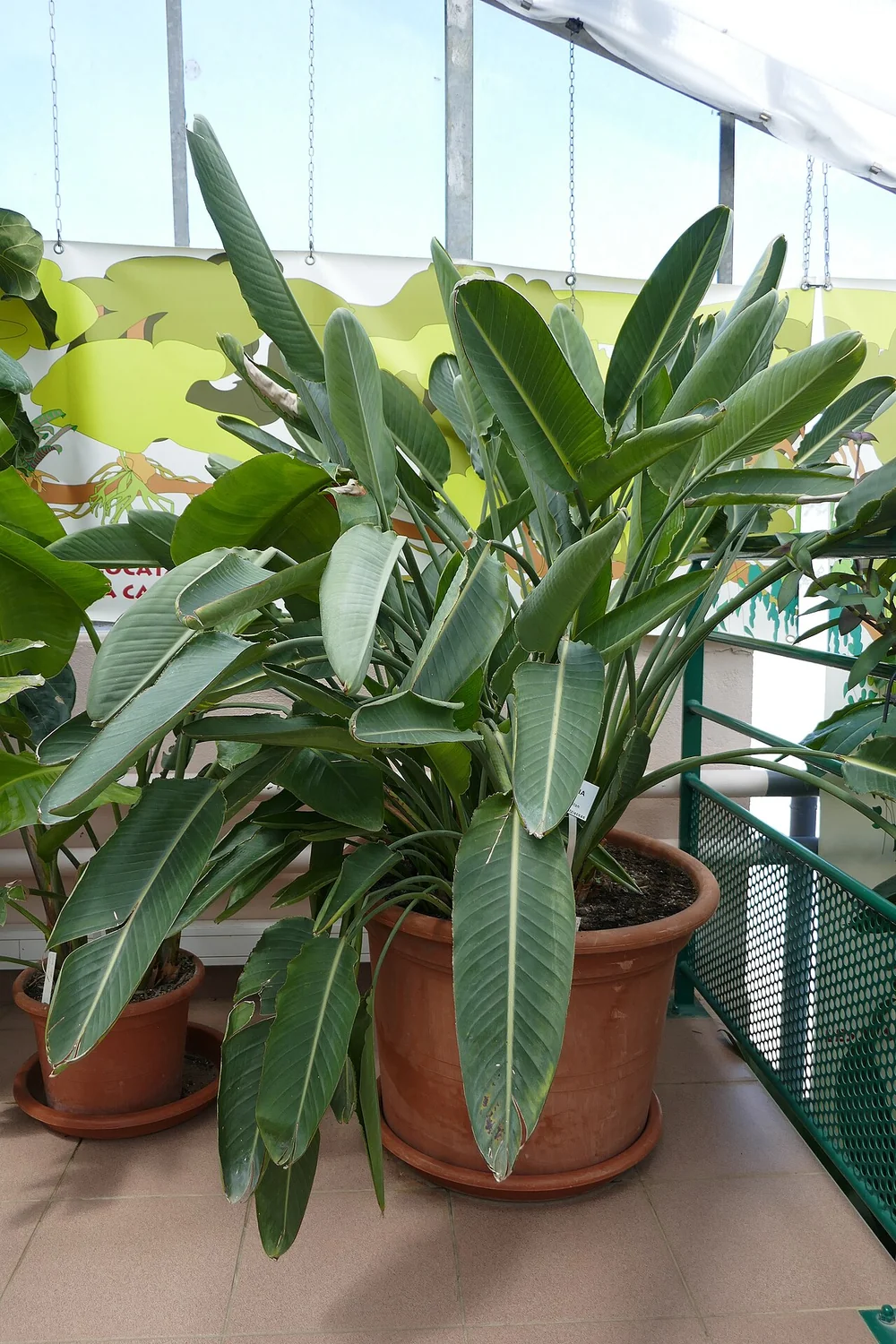
The Leafy Plant beneath the Famous Flowers
Orange bird of paradise is famous for its birdlike flowers, but a container owner should first understand the permanent leafy plant beneath them. Strelitzia reginae forms a clump of stiff paddle-shaped leaves arising from rhizomes, with the stalks arranged into a fanlike structure. It is an herbaceous perennial rather than a woody indoor tree. Its relatively compact stature compared with white bird of paradise can suit a bright home, yet it still needs more room and light than a small tropical desk plant. Choose it because the foliage and growth habit are welcome even during a long period without flowers.
The species is native to South Africa. Its genus honors the Mecklenburg-Strelitz connection of Queen Charlotte, and the regal epithet reinforces that naming history. Those facts explain a botanical name, not a requirement to assign royal symbolism to every gift. The orange and blue floral display has made it widely recognizable, but cultivated forms can differ, including yellow-flowered selections. Keep the actual cultivar when known. A plant label and a reliable identification help distinguish it from taller related species or unrelated plants sold with the words bird of paradise in their names, some of which have entirely different leaves and growing needs.
A Truly Bright Indoor Position
Place it in a very well-lit position, ideally with suitable direct sunshine introduced gradually after nursery shade. A bright sunroom, conservatory, or sunny indoor window is more realistic for sustained growth and possible flowering than an ordinary office with remote windows. Light that is adequate for people reading at a desk may still be insufficient for this plant. The rigid leaves also need sideways clearance. An emerging blade rises before it settles into its final fan, so avoid placing the pot beneath a shelf that catches new growth. If outdoor summer conditions are suitable, acclimate the plant and protect it from sudden temperature changes.
During active growth, water thoroughly once the upper medium has begun to dry, then drain. Its fleshy roots and rhizomes should not remain in stale water. A tightly rooted plant in bright summer conditions may use water quickly, while a cool lower-light winter specimen needs less. Check the central root ball if a new potting layer has been added. Water can run around a dry nursery core without adequately wetting it, or a dense core can remain wet beneath a dry outer surface. A thoughtful moisture check is more useful than declaring a universal number of days between waterings for every room and season.
Roots, Maturity, and Careful Leaf Handling
Use a fertile, open potting medium and a draining container strong enough for the developing clump. Do not move a small plant into an enormous pot simply to encourage earlier flowers. Some root restriction is tolerated, but extreme congestion can make water management difficult. Repot when there is a genuine root or medium reason, preserving the crown level and handling fleshy roots carefully. A mature clump can sometimes be divided, but each portion needs enough roots and growth to establish. Division may interrupt the immediate display, so it should be planned as propagation or renewal rather than performed casually to make several instant gifts.
Flowering depends on maturity and favorable growing conditions. A young plant may take years before it has the resources to bloom, and an indoor specimen in inadequate light may remain a foliage plant. No special bloom booster replaces that combination. If a stalk appears, give it clearance and let it develop without repeated moves into darker decorative locations. Remove spent floral material carefully after it finishes. Continue caring for the leaves, since they support the next cycle. A flower is one outcome of the plant's development, not a signal to abandon ordinary root care or to demand another stem immediately afterward.
Letting Leaves Unfold and Interpreting Outer Leaf Loss
The leaves should be allowed to unfold on their own. Pulling apart a rolled blade risks damage that remains visible for its lifetime. Some splitting can occur through handling and air movement without indicating a serious cultural problem. Support a blade while wiping dust from its broad surfaces, and keep it clear of furniture edges that create repeated tears. When a leaf becomes completely spent, remove its stalk near the base without cutting adjacent living growth. Cutting all leaf tops to one height will not produce a shorter, healthier clump. It simply replaces the plant's natural architectural fan with damaged ends.
Feed during active growth at a suitable labelled rate, reducing inputs when light and growth fall. Inspect for scale, mealybugs, and mites around sheltered stalk bases and leaf undersides. A new purchase or a plant returning from outdoor summer care deserves a close check before it joins an established indoor collection. If several leaves yellow at once, investigate drainage and roots alongside pests and recent environmental changes. An ageing outer leaf on an otherwise vigorous clump is a different event. Keep major interventions separate where practical so their effects can be understood instead of obscured by simultaneous repotting, pruning, feeding, and relocation.
A Celebratory Gift with Flowering Patience
As a gift, orange bird of paradise can personally suggest celebration, energy, or an adventurous new chapter because of its vivid flowers and upright foliage. That is a modern message chosen by the giver, not a universal traditional code or a promise that the plant will create happiness. The recipient must have substantial light and an interest in the leafy plant even before it flowers. Strelitzia can be harmful to pets if chewed, so confirm a suitable household arrangement. A card stating that flowering may require patience is more considerate than a promise of annual indoor blooms that the available conditions may never support.
Over time, a successful plant develops a sturdy fan of replacement leaves and a root system matched to its container. Give it the light and space needed to maintain that form, and view any flowers as part of a longer biological process. If the intended office position cannot provide enough brightness, choose another location before the clump becomes weak and difficult to handle. Strelitzia reginae has an architectural role without needing to be called a woody tree. Understanding its South African origins, rhizomatous habit, maturity, and flowering limits creates a more useful relationship than treating its famous flower as an instant decorative product.