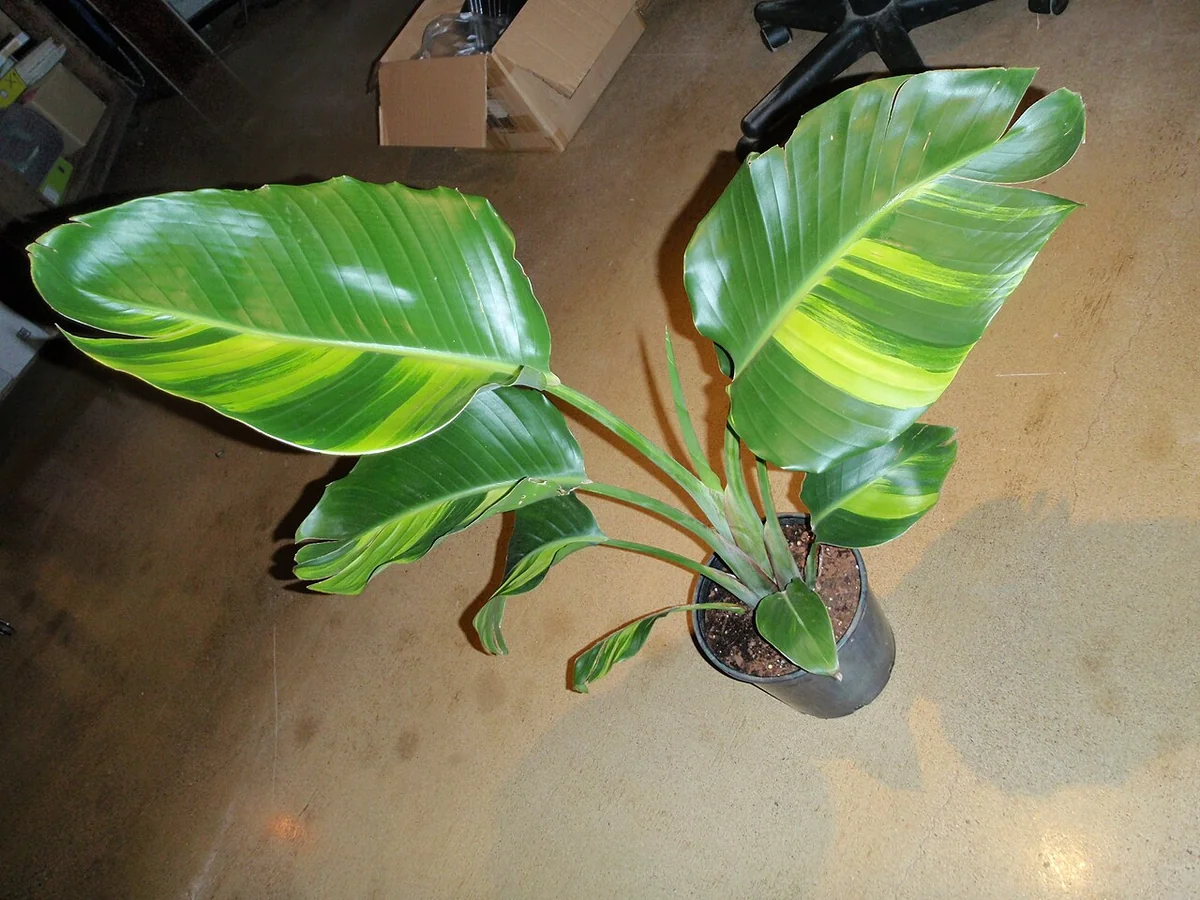
A Giant Herb in an Indoor-Tree Role
White bird of paradise is frequently used where an interior needs the visual impact of a tree. Strelitzia nicolai carries large paddle-shaped leaves on strong upright stalks, and an established clump can develop a towering silhouette. Botanically it is an architectural herbaceous perennial rather than a conventional woody branching tree. That distinction matters when deciding how it can be reduced or renewed. A small nursery specimen is the beginning of a large plant, not a permanently compact decorative form. Before buying, measure the height, sideways reach, and opening path of a future leaf as carefully as the available floor area.
The species is native to parts of southeastern Africa, associated with coastal forest and dune environments. It belongs to the Strelitzia group named in connection with Queen Charlotte's Mecklenburg-Strelitz heritage, while the species epithet commemorates a historical Russian imperial name. Those naming histories are botanical context rather than instructions about its meaning as a gift. Mature plants produce distinctive white and blue flowers within dark, boat-shaped bracts, but indoor young plants are normally grown chiefly for foliage. A room should be selected to support large leaves first, not decorated on a promise that spectacular flowers will appear on a fixed schedule.
Abundant Light and a Reachable Root Ball
Give it substantial brightness. A large window, conservatory, or well-lit atrium is a more realistic long-term home than an ordinary dark office corner. Gentle direct sun can be introduced progressively when the plant has been nursery-grown under shade. Leaves formed in subdued conditions can scorch after an abrupt move. The top of the plant may reach brighter light while lower leaves remain shaded by furniture, so consider the whole clump. A tall pot does not solve that problem. Adequate light should be accompanied by enough overhead clearance for a rolled leaf to rise and unfold without hitting a ceiling fitting.
Water when the upper medium has begun drying, then supply enough to reach the substantial root mass and let the surplus leave. An actively growing plant with large leaves can use considerable water, but low light and cool roots reduce that demand. Do not confuse a big canopy with a permanent requirement for wet compost. Check the occupied nursery core if fresh medium has recently been added around it. One texture may remain wet while another feels dry. A hidden cachepot reservoir is especially troublesome with a large display whose base is difficult to reach. Plan inspection access before the plant becomes heavy.
Supporting Roots and Unfolding Leaves
Use a fertile, open container mix and a stable draining pot. The roots and rhizomatous base can be substantial, so eventual repotting is a physical task that may require assistance. Increase size in proportion to the roots rather than placing a small plant immediately inside an enormous wet volume. Keep growing bases at their previous depth. A broad, securely supported container helps balance the tall leaves, but stability must not come at the cost of blocked drainage. Arrange a safe moving route, accounting for door height and leaf spread. Large foliage can be damaged simply by forcing a plant through an opening it no longer fits.
Splits in the leaf blades are a normal structural possibility, especially after wind or handling, and do not automatically indicate poor humidity or a pest. In nature, the broad leaves encounter moving air; indoors, even a small collision can produce a long tear. Preserve useful green area rather than removing every imperfect leaf. A leaf that is still rolled should not be pulled apart to hurry its opening. Examine the growing conditions if successive leaves fail, but do not use fingers to force a delicate blade into the shape desired for a photograph. Its final surface cannot be repaired once torn.
Large-Leaf Removal without Damaging the Growing Clump
Remove a completely spent leaf by cutting its stalk carefully near the base without injuring neighboring growth. Do not chop across the highest leaves to make an oversized plant fit a ceiling. That removes the display without turning the clump into a shorter branching tree. Where an established plant can be divided, the operation requires adequate rooted sections and a suitable recovery environment. It is not a convenient weekly size-control technique. Feed during active growth according to a suitable label, while recognizing nutrients already in fresh compost. Strong fertilizer cannot substitute for the light and room required to support another large leaf.
Dust can be wiped from the broad blades with support beneath them, including the area around the central vein. Inspect leaf undersides and the protected bases for mites, scale, or mealybugs. A plant that spent summer outdoors should be checked before returning to other houseplants. If pests appear, identify and isolate the problem rather than treating every leaf split as insect damage. Watch the root environment when several leaves yellow together. A single old blade retiring from the outside of a vigorous clump is different from deterioration affecting newly emerging growth. Recent moves, temperature changes, and watering history provide useful diagnostic context.
An Expansive Gift Requires an Agreed Home
White bird of paradise can be an impressive gift for someone who has explicitly wanted a large architectural plant and can supply a very bright space. The broad leaves might personally express an expansive new beginning or a welcome into a new home. Those are chosen meanings, not a traditional promise of freedom, wealth, or wellbeing automatically attached to the species. It is a poor surprise for a small apartment. Strelitzia can be harmful to pets if chewed, so discuss animal access and verify the exact plant with an authoritative reference. Provide an honest account of future size rather than describing the current nursery height as its limit.
Its success indoors is measured by sound replacement leaves and a manageable relationship with the room. Allow enough space for expansion, keep drainage accessible, and reassess the position before the crown reaches an obstruction. If the plant outgrows the building, rehoming is more realistic than repeated destructive cuts. Strelitzia nicolai deserves to be understood as a giant herbaceous clump with a tree-like visual role. That identity makes its appeal more interesting, not less, and supports a practical care plan based on abundant light, robust roots, careful handling, and a realistic horizon for its impressive growth.